
How Operating Weight Affects Mini Excavator Stability on Uneven Ground (Without Rolling You Down the Hill)
How operating weight affects mini excavator stability on uneven ground becomes a very serious topic the moment one track starts lifting off the soil and the operator stops breathing. On paper, operating weight is just a specification. On a slope with loose gravel and a full bucket, it becomes a physics lesson with consequences.
In simple terms: weight can make your machine feel planted — or it can turn it into a reluctant sled. The difference lies not in how heavy the excavator is, but in how that mass interacts with centre of gravity, track width and ground conditions.

First: What Do We Actually Mean by Operating Weight?
Operating weight includes the base machine, bucket, fuel, hydraulic oil and operator. Add a breaker or auger and the balance shifts. Think of it like carrying a backpack — same person, very different posture once you strap 30 kg to the front.
Manufacturers publish tidy numbers. Real sites add mud, slope and optimism.
Is Heavier Always More Stable?
This is where assumptions get people into trouble.
When More Weight Helps
- Better resistance to forward tipping during digging
- Less “bouncing” when swinging a loaded bucket
- Higher inertia against sudden movements
On firm, compacted ground, a heavier 2-tonne machine will usually feel more composed than a 1.2-tonne unit.
When More Weight Becomes a Problem
- Higher ground pressure on soft soil
- Increased sinkage on uneven surfaces
- Greater energy if it does decide to tip
On wet clay or loose backfill, heavier can mean deeper ruts — and deeper ruts mean unexpected tilt angles. That is when stability maths becomes reality.
Centre of Gravity: The Invisible Boss
Operating weight matters, but centre of gravity (CoG) decides how that weight behaves. Raise the boom fully on a side slope and the CoG shifts upward and outward. Extend the arm downhill and you’ve effectively asked physics to test your confidence.
A heavier machine with a low-mounted engine and well-placed counterweight often feels steadier than a lighter machine with weight positioned higher. It’s not just about kilograms — it’s about where those kilograms live.
Side Slopes: Where Confidence Is Tested
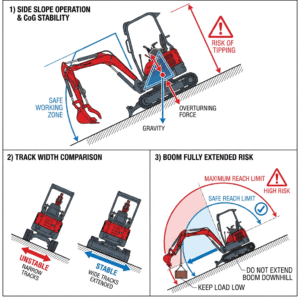
When travelling across a slope:
- Track width defines your base of support.
- CoG height defines how easily you tip.
- Operating weight defines how much force is involved.
A heavier excavator may resist small shifts better. But once the tipping line is crossed, gravity does not negotiate.
Ground Pressure: The Quiet Trouble-Maker
Ground pressure equals operating weight divided by track contact area. Increase weight without increasing track width and you increase pressure. On uneven or soft ground, one track may sink slightly more than the other. That small difference becomes a noticeable lean.
And that lean, combined with a swinging load, can feel much larger than the numbers suggest.
Dynamic Stability: It’s Not Just Standing Still
Static stability is what engineers calculate. Dynamic stability is what operators experience.
During digging:
- Extending the boom shifts mass forward.
- Swinging creates centrifugal force.
- Sudden bucket release shifts load instantly.
Heavier machines dampen these movements better, but they also generate greater forces when momentum builds. Smooth operation matters more than bravado.
Does a Bigger Counterweight Fix Everything?
Counterweights help resist forward tipping. They do not magically stabilise side slopes or poor positioning. A well-balanced lighter excavator can outperform a heavier but poorly distributed machine.
Think of it like carrying shopping bags: one in each hand feels balanced. All of them in one hand feels educational.
Uneven Ground Changes Everything
Perfectly level surfaces are rare outside showrooms. On real sites:
- One track may sit on compacted soil.
- The other may sit on fill.
- Hidden voids shift under load.
Heavier machines compress soil more aggressively. That compression may stabilise firm ground — or destabilise soft sections.
So, Is Heavier Safer?
Sometimes. But only when:
- The ground can support the additional load.
- The track width matches the weight class.
- The operator keeps the boom low while travelling.
- Swing movements are controlled, not theatrical.
Stability on uneven ground is a geometry problem, not a weightlifting contest.
Practical Engineering Takeaways
- Match operating weight to soil bearing capacity.
- Prioritise wider undercarriage over simply higher mass for slope work.
- Keep loads low and movements smooth on uneven terrain.
- Remember that centre of gravity moves every time the boom does.
Operating weight influences stability, but it does not guarantee it. A heavier mini excavator may feel reassuringly planted — until uneven ground introduces variables. In the end, physics always wins. The goal is to work with it, not argue with it halfway down a slope.