
Skid Steer ROC vs Tipping Load: What Buyers Need to Know
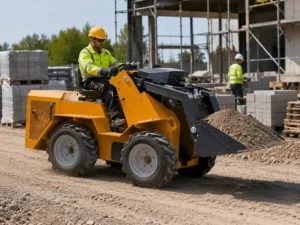
Quick answer: Rated operating capacity, or ROC, is the working-load figure buyers should use when comparing skid steers. Tipping load is the tested point at which the machine reaches its forward stability limit, so it should never be treated as normal carrying capacity. Many wheeled skid steers use an ROC equal to 50% of tipping load, while compact track loaders may also display a 35% rating. Before comparing two machines, buyers must check the rating percentage, attachment setup and operating conditions behind each number.
A 4,000 lb tipping-load figure may look impressive on a specification sheet, but it does not mean the loader should travel around with a 4,000 lb pallet. Gravity has never been particularly interested in marketing claims. A sensible comparison starts with ROC, then considers attachment weight, load position, lifting height and ground conditions.
What Is ROC on a Skid Steer?
Skid steer rated operating capacity is the manufacturer’s published working-load rating under a defined test setup. It gives buyers a practical starting point for comparing machines, but it should always be read together with the notes below the specification table.
The John Deere 320G provides a clear example. It has a published tipping load of 4,380 lb and an SAE rated operating capacity of 2,190 lb, which is exactly 50% of the tipping load. This relationship is common on wheeled skid steers, although the test configuration still matters. Source: John Deere 320G specifications.
Caterpillar shows why buyers should not treat ROC as a universal payload for every attachment. The Cat 226D3 has a published ROC of 1,550 lb, but that figure is based on a 165 lb operator, full fluids, a 62-inch low-profile bucket, standard-flow hydraulics, a manual quick coupler and no optional counterweights. Replace the bucket with long forks or a heavy grapple, and the machine geometry changes even though the brochure number stays the same. Source: Cat 226D3 specifications.
| Official machine example | Tipping load | Published ROC | Rating basis |
|---|---|---|---|
| John Deere 320G skid steer | 4,380 lb | 2,190 lb | 50% |
| Cat 299D3 compact track loader | 9,945 lb | 3,480 lb | 35% |
| Cat 299D3 compact track loader | 9,945 lb | 4,970 lb | 50% |
What Does Skid Steer Tipping Load Mean?
Tipping load is the tested point at which the loader reaches its forward stability limit. As the test load increases, the rear of the machine eventually begins to lift. This number helps explain how ROC is calculated, but it is not extra working capacity waiting to be used.
The easiest way to separate the two terms is simple: tipping load shows where stability runs out, while ROC provides a lower rated reference for normal machine selection. Breakout force is different again. It measures how strongly the bucket or lift system can overcome resistance while digging or curling, not how much weight the machine can safely carry across the site.
Is ROC Always 50% of Tipping Load?
No. Many wheeled skid steers publish ROC at 50% of tipping load, but compact track loaders may use either a 35% or 50% rating. The percentage can change the headline number dramatically even when the machine itself does not change.
Caterpillar lists the Cat 299D3 compact track loader at 3,480 lb ROC when calculated at 35% of its 9,945 lb tipping load. The same machine is also listed at 4,970 lb when the 50% method is used. The two ROC figures differ by 1,490 lb, or about 42.8%, simply because the reporting basis changes. The loader has not suddenly become stronger; the maths has changed clothes. Source: Cat 299D3 specifications.
For this reason, buyers should never compare compact track loaders by headline ROC alone. First confirm whether each value is based on 35% or 50% of tipping load. Then compare the attachment, counterweight and machine configuration used for the rating.
Does Attachment Weight Reduce Usable Capacity?
Yes. The loader must support the attachment as well as the material being carried. A fork frame, grapple or heavy bucket does not become weightless when it connects to the quick coupler.
Caterpillar lists a 48-inch Class II pallet-fork group at 429.9 lb. Compared with the Cat 226D3’s 1,550 lb ROC, an attachment of that weight represents about 27.7% of the headline capacity before a pallet is added. That percentage is useful as an early warning, but buyers should not simply subtract 429.9 lb from 1,550 lb and call the result an approved pallet capacity. Source: Cat pallet-fork specifications.
The 226D3 ROC was established with a 62-inch bucket, so changing to pallet forks also changes the attachment weight, geometry and load centre. The correct reference is an OEM-approved load chart or attachment specification for the actual machine setup.
| Capacity check | What the buyer should confirm |
|---|---|
| Published ROC | Whether the figure uses a 35% or 50% rating basis |
| Test configuration | The bucket, coupler, tyres or tracks and counterweight setup |
| Attachment weight | Total weight of the fork frame, grapple or heavy bucket |
| Load centre | How far the load’s centre of gravity sits from the coupler |
| Working conditions | Boom height, slope, surface condition, turning and braking |
Why Load Centre and Boom Height Matter
The same load becomes less stable as it moves farther away from the machine. A bucket normally holds material close to the coupler, while a long pallet may place its centre of gravity much farther forward. That extra distance creates a larger overturning effect, even when the load weight has not changed.
Boom height creates a similar problem. OSHA explains that longitudinal stability decreases when a load is raised or moved farther away from a powered industrial vehicle. OSHA skid-steer training material also notes that stability decreases as the loader arms rise. The practical rule is straightforward: carry the load low, keep it close and raise it only when positioning or dumping. Source: OSHA stability guidance.
Sharp braking, fast turns, rough ground and slopes add forces that a static ROC figure does not fully describe. A machine that feels comfortable on level concrete can behave very differently when the same load is raised on uneven soil. ROC is the starting point; the jobsite usually supplies the surprises at no extra charge.
Do Counterweights Increase Skid Steer ROC?
Factory-approved counterweights can increase published ROC, but the gain is normally specific and limited. Caterpillar lists the Cat 226D3 at 1,550 lb ROC in its standard configuration and 1,650 lb with optional counterweights. That is an increase of 100 lb, or approximately 6.5%.
| Cat 226D3 configuration | Published ROC | Change |
|---|---|---|
| Standard configuration | 1,550 lb | — |
| With optional counterweight | 1,650 lb | +100 lb |
| Percentage increase | — | Approximately 6.5% |
Buyers should use the revised manufacturer rating rather than assuming that every pound added behind the cab creates an equal increase in lifting capacity. Unapproved ballast may also affect transport weight, tyres, balance and machine handling.
How to Choose the Right Skid Steer Lift Capacity
Start with the heaviest load the skid steer will handle regularly, not the unusual load it may encounter once a year. Next, confirm the attachment weight, expected load centre and maximum lifting height. Finally, consider whether the work involves slopes, soft ground, frequent turning or operators with different experience levels.
A useful buying framework is:
Expected material weight + attachment effects + load-position allowance + jobsite capacity reserve = required machine class
This is a selection framework, not an OEM-approved lifting formula. For pallet work, use the full pallet weight and actual centre of gravity. For bucket work, estimate material weight from bucket volume and reliable loose-material density data. Wet soil and demolition debris are particularly talented at making a bucket heavier than it looks.
Skid Steer ROC vs Tipping Load FAQ
Can a skid steer lift more than its ROC?
The hydraulic system may physically raise a heavier load in some boom positions, but that does not make the load suitable for normal carrying, turning or full-height placement. Routine work should follow the published ROC, approved attachment data and operator manual.
Is breakout force the same as lift capacity?
No. Breakout force measures the force available to overcome resistance while digging or curling. ROC is the more relevant figure when comparing normal load-handling capacity.
Does a pallet-fork rating increase machine ROC?
No. A fork frame may have a structural rating that is much higher than the loader’s ROC, but it does not increase the machine’s rated operating capacity. The lowest applicable machine, attachment or stability limit controls the job.
Should buyers compare ROC or tipping load?
Use ROC for initial machine selection, but always check the percentage and configuration behind it. Tipping load explains the rating basis; it is not the normal working payload.
Final Buying Rule
When comparing skid steer ROC vs tipping load, treat ROC as the first filter rather than the complete answer. Confirm whether the figure is rated at 35% or 50%, read the OEM configuration notes, account for the attachment and load centre, and leave additional capacity for raised loads, slopes and uneven ground.
A loader that only matches the expected load under perfect conditions is usually too small for comfortable daily work. Before requesting a quotation, provide the expected material weight, attachment type, maximum lifting height and ground conditions. These details make it easier to choose a skid steer with a practical operating margin instead of relying on one impressive number.