
A mini excavator does not become better simply because it becomes heavier.
For most buyers, the real question is much simpler: Can the machine enter the jobsite, dig deep enough, use the attachments you need and still be easy to transport?
In the ACE CX range, the difference is easy to see. The CX12-5 represents the compact 1-ton class, the CX18 moves into the 1.5–1.8 ton working range, while the CX20T and CX20A move closer to the 2-ton class for buyers who need more digging capacity and a larger working envelope.
One important detail: “1 ton”, “1.5 ton” and “2 ton” are useful shopping categories, but the real operating weight is rarely an exact round number. The current CX12-5 specification lists 1,180 kg, the CX18 1,780 kg, the CX20T 1,950 kg, and the CX20A parameter table lists 2,130 kg. That is why serious buyers should compare the actual specification sheet, not just the name of the weight class.
Quick Comparison: Which ACE CX Size Fits Your Work?
| ACE model | Operating weight | Key size / working data | Best starting point for |
|---|---|---|---|
| CX12-5 | 1,180 kg | 750/990 mm adjustable working width, 0.024 m³ bucket | Gardens, farms, light trenching, narrow jobs |
| CX18 | 1,780 kg | 990–1,300 mm track width, 2,326 mm dig depth | Landscaping, drainage, contractors, rental |
| CX20T | 1,950 kg | 1,060 mm overall width, 0.06 m³ bucket | Utility work, construction, multi-attachment jobs |
| CX20A | 2,130 kg | 1,215 mm width, 14 kN bucket force | Regular trenching, grading and earthmoving |
These numbers make the buying decision much easier. The CX12-5 is mainly about keeping the machine small. The CX18 adds working range and hydraulic capacity. The CX20T stays surprisingly narrow for a machine close to two tonnes, while the CX20A gives buyers a heavier platform with published digging-force data.
Choose the CX12-5 When Access Comes First
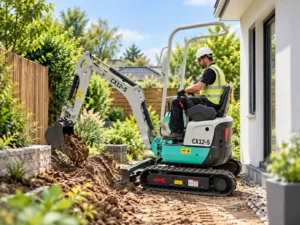
A 1-ton-class mini excavator is most useful when the first problem is getting the machine to the work.
The ACE CX12-5 mini excavator is a good example. Its current product specification lists an operating weight of 1,180 kg, a standard bucket capacity of 0.024 m³, and a dozer width that can be set at 750 or 990 mm. The machine uses a Kubota D722 diesel engine rated at 10.2 kW, with pilot operation for the controls.
That makes the CX12-5 suitable for garden work, farm maintenance, drainage trenches, property renovation and other jobs where a larger excavator may simply be too wide.
This is the main advantage of a smaller machine: it can reach places where extra digging power is useless because the excavator cannot get through the entrance in the first place.
A two-ton machine sitting outside a narrow gate may have plenty of power. Unfortunately, the trench is still on the other side.
The CX12-5 also shows why buyers should not expect a small excavator to behave like a larger contractor machine. Its bucket is smaller and the machine has less mass available for heavier tools. If the normal job is light trenching and landscaping, that is fine. If the machine will spend every day breaking hard ground or moving larger volumes of soil, moving up a class usually makes more sense.
Choose the CX18 When You Need More Capability Without a Big Machine
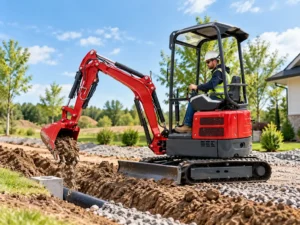
For many small contractors and rental companies, the move from roughly one tonne to the 1.5–1.8 ton class is where the machine starts to feel much more useful for everyday work.
The ACE CX18 compact excavator has a published operating weight of 1,780 kg. Its undercarriage adjusts from 990 to 1,300 mm, so the operator can keep the machine narrow for access and widen it when more working stability is useful. Maximum digging depth is 2,326 mm, while maximum reach at ground level is 3,848 mm.
The hydraulic system is also a clear step up. ACE lists a variable-displacement main pump with a maximum discharge flow of 39.6 L/min. Travel speed is 2.6 km/h in low range and 4.5 km/h in high range, with a maximum drawbar pull of 12.9 kN.
Those figures explain why this size works well for landscaping, drainage, small foundations, municipal maintenance and farm work. The machine is still compact, but it has more reach, more hydraulic capacity and a wider working stance than the CX12-5.
The CX18 also uses a 660 mm tail-swing radius and an upper-structure width of 980 mm, which helps when working near walls, fences and other obstacles.
This is the size to consider when the one-ton machine looks attractive on the trailer but starts to feel a little too small once the digging begins.
Choose the CX20T When You Want a Compact 2-Ton Machine
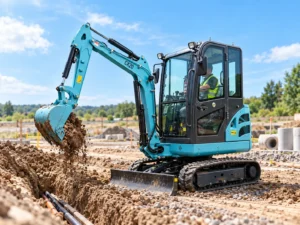
Moving toward two tonnes does not automatically mean buying a wide machine.
The ACE CX20T 2-ton mini excavator is a useful example. It has a published operating weight of 1,950 kg, yet its overall width is only 1,060 mm. The standard bucket capacity is 0.06 m³, and the machine uses an 11.2 kW Yanmar 3TNV74 diesel engine. ACE also lists a retractable chassis and pilot-valve controls.
That combination makes the CX20T interesting for contractors who need more working capacity but still spend time on urban jobs, landscaping projects or utility work where space is limited.
Attachment choice is another reason to move up. The current CX20T page lists buckets in several widths as well as a quick hitch, ripper, wood grab, rake, auger and hydraulic breaker.
For a buyer, that means the machine is not just being purchased to dig one trench. It can become a compact attachment carrier for different jobs during the week.
That matters for rental fleets too. A machine that can dig on Monday, run an auger on Tuesday and use a breaker later in the week has a better chance of staying busy than a machine that only does one thing well.
Choose the CX20A When Digging Work Becomes the Main Job
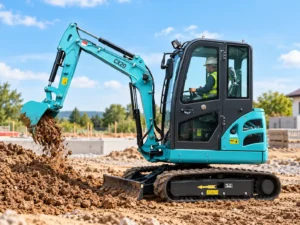
The CX20A moves slightly higher again.
ACE positions the CX20A mini crawler excavator as a 2.2-ton class machine, while the current parameter table lists an operating weight of 2,130 kg. It has an overall width of 1,215 mm, a 0.06 m³ bucket, maximum digging depth of 2,154 mm, bucket digging force of 14 kN and arm digging force of 10 kN. Travel speed reaches 4.5 km/h.
This makes the CX20A easier to understand as a buying choice. Compared with the CX12-5, you are giving up some narrow-access advantage. In return, you get a heavier working platform, a larger bucket and published digging-force figures suited to regular trenching, grading and earthmoving.
The CX20A also offers Yanmar, Perkins and Kubota engine configurations on the current product page. That can matter for overseas dealers who already have local parts support for one engine brand.
There is no need to buy this size because “2 ton sounds more professional.” Buy it when the work actually needs it.
Which CX Mini Excavator Fits Different Jobs?
| Jobsite | Better CX starting point | Why |
|---|---|---|
| Small garden or narrow property | CX12-5 | Compact size is the main advantage |
| Farm drainage and light trenching | CX12-5 / CX18 | Choose by depth and daily workload |
| Landscaping contractor | CX18 | Good balance of width and working range |
| Rental fleet | CX18 / CX20T | Broader job and attachment coverage |
| Utility trenching | CX18 / CX20T | More reach and hydraulic capacity |
| Regular construction digging | CX20T / CX20A | Larger bucket and stronger working platform |
| Grading and earthmoving | CX20A | Better suited to repeated heavier work |
The important point is that these are starting points, not rules.
A landscaper with a 900 mm gate may prefer a smaller machine even if the digging work is fairly heavy. A contractor on an open site may happily use a CX20A because access is not a problem.
The jobsite always gets the final vote.
Do Not Choose Only by Machine Weight
Operating weight is useful, but it does not tell you everything.
For example, the CX18 weighs 1,780 kg, but the track width can change from 990 to 1,300 mm. ACE lists its ground pressure at 29.4 kPa. This is why width, track contact area and working setup matter when the machine operates on lawns, farms or softer ground.
Hydraulics matter as well. If the buyer plans to use an auger, breaker, grapple or another hydraulic attachment, the machine’s flow and pressure need to match the attachment.
A machine can be the right weight and still be the wrong machine.
That is an expensive lesson to learn after the container arrives.
What Should a Buyer Send Before Asking for a Quote?
Before comparing the CX12-5, CX18, CX20T or CX20A, prepare the narrowest site access, required digging depth, soil condition, normal attachments, working hours per day, transport limit, destination country and order quantity.
That gives the sales engineer enough information to recommend a machine for the actual job instead of guessing from a simple request such as “send me your best excavator.”
There is no best excavator for every site. There is only the excavator that fits the work better.
FAQ
Is the CX12-5 a true 1-ton mini excavator?
ACE positions the CX12-5 in the 1-ton class, while its current specification lists an actual operating weight of 1,180 kg. This is a good example of why buyers should check real operating weight instead of assuming the class name is an exact scale reading.
Is the CX18 better than the CX12-5?
It depends on the job. The CX18 is heavier and offers 2,326 mm digging depth, adjustable 990–1,300 mm track width and up to 39.6 L/min main-pump flow. The CX12-5 is smaller and better suited when access is the main problem.
What is the difference between CX20T and CX20A?
The CX20T is the narrower of the two based on current published specifications: 1,060 mm overall width and 1,950 kg operating weight. The CX20A parameter table lists 1,215 mm width and 2,130 kg operating weight, together with 14 kN bucket digging force and 10 kN arm digging force.
Which ACE CX model is better for a rental fleet?
The CX18 and CX20T are sensible models to compare because both remain compact while covering a wider range of trenching, landscaping and attachment work. The final stock choice should depend on the jobs local rental customers request most often.
Final Choice: Start With the Job, Not the Number on the Side
For tight access and lighter digging, start with the CX12-5.
If you want a machine that is still compact but can handle a broader range of daily contractor work, look closely at the CX18.
If you need a machine close to two tonnes while keeping overall width under control, compare the CX20T.
For buyers who expect regular trenching, grading and earthmoving and want a heavier working platform, the CX20A is the next step.
That is a more useful way to compare mini excavators than simply saying: 1 ton is small, 1.5 ton is medium, and 2 ton is strong.
The real decision is about access, digging depth, hydraulics, attachments and the work the machine needs to do every week.