
Are Skid Steer Attachments Universal? A Complete Compatibility Guide
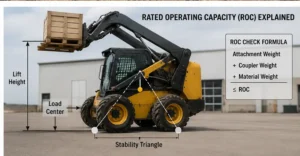
Quick answer: Many modern full-size skid steer attachments can be exchanged between brands when the loader and attachment use the standard skid steer quick attach system, commonly known as SSQA. However, a universal mounting plate does not guarantee complete compatibility. Buyers must also check the machine’s rated operating capacity, attachment weight, hydraulic flow, pressure, hose connections, case-drain requirements and electrical controls. Mini loaders, older machines and proprietary couplers may use different mounting systems.
In simple terms, an attachment can fit perfectly and still be completely wrong for the machine. Locking onto the mounting plate is only the first test. The attachment must also be light enough to carry, suitable for the loader’s hydraulic system and equipped with controls the operator can actually use. Otherwise, the new attachment may become a very expensive piece of yard decoration.
What Does “Universal” Mean for Skid Steer Attachments?
The word “universal” normally refers to the mechanical mounting interface. ISO 24410:2020 defines dimensional requirements for skid steer quick couplers and attachment mounting frames, helping attachments move between machines that follow the same standard. The standard also recognises that other coupler designs exist, so not every loader or attachment is automatically interchangeable. Source: ISO 24410:2020.
This distinction is important because mechanical fit and operating compatibility are not the same thing. A basic bucket may only require the correct mounting plate, suitable width and enough machine capacity. A powered mulcher, auger or snow tool may also need a specific hydraulic flow, operating pressure, case-drain line and electrical connector. The plate opens the door, but the rest of the machine still has to walk through it.
Seven Skid Steer Attachment Compatibility Checks
Before ordering an attachment, work through the following seven checks. They form a practical buying framework for separating a simple mechanical fit from a complete working match.
| Compatibility check | What to confirm |
|---|---|
| Mounting interface | SSQA, mini-loader mount or a proprietary coupler |
| Machine capacity | ROC, lift height and the approved attachment range |
| Attachment weight | Empty attachment weight plus material or payload |
| Hydraulic flow | Machine output is within the attachment’s stated range |
| Hydraulic pressure | Available pressure meets, but does not exceed, the specification |
| Hydraulic connections | Coupler size, hose count, return line and case drain |
| Electrical controls | 7-pin, 14-pin, separate controller or no electrical plug |
Not every attachment needs all seven items. A standard bucket has fewer requirements than a forestry mulcher. Even so, every relevant point should be checked against the exact loader model rather than guessed from the brand name.
Mechanical Fit Does Not Guarantee Hydraulic Compatibility
Hydraulic attachments must operate within the manufacturer’s published flow and pressure range. Hydraulic flow, usually measured in gallons per minute, affects operating speed. Pressure affects the force or torque available to perform the work. Labels such as “standard flow” and “high flow” are useful, but the actual numbers matter more.
The Cat A41 auger provides a clear example. It uses a skid steer loader coupler and standard-flow hydraulics, but Caterpillar specifies an optimal flow range of 11–22 gpm and an optimal pressure range of 2,100–3,400 psi. The attachment also weighs 366 lb. A loader may accept the mounting plate while still falling outside the auger’s required hydraulic range. Source: Cat A41 specifications.
| OEM attachment | Published requirements | What the figures show |
|---|---|---|
| Cat A41 auger | 366 lb; 11–22 gpm; 2,100–3,400 psi | The mounting plate and hydraulic system must both match |
| Cat MB250 mixing bucket | 948 lb; 0.33 yd³; 16–18 gpm; 2,031–2,901 psi | Weight, loaded capacity and hydraulics must be checked together |
| Cat 9 ft Snow Wing | 1,951.1 lb; 20–23 gpm; 2,800–3,300 psi; 14-pin | Electrical control can be part of attachment compatibility |
| Bobcat heavy-duty flail mower | Case drain; stopping time no more than 7 seconds | A third hydraulic line may be a defined operating requirement |
The Cat MB250 mixing bucket shows why attachment weight cannot be considered on its own. It weighs 948 lb before any material is added, holds 0.33 yd³ and requires 16–18 gpm at 2,031–2,901 psi. It is also 63.2 inches wide overall. The carrier must support the empty attachment, the material inside it, the hydraulic demand and the required working width. A bucket that connects but overloads the loader is not compatible; it is simply attached. Source: Cat MB250 specifications.
Does Attachment Weight Reduce Usable Capacity?
Yes, although the calculation is not always as simple as subtracting attachment weight from the published ROC. Manufacturers often establish ROC with a particular bucket, coupler, tyre or counterweight configuration. Replacing that bucket with a heavy grapple, mixing bucket or adapter changes both the weight and the position of the load.
Attachment geometry matters because weight placed farther in front of the coupler creates a greater overturning effect. A thick adapter plate or long pallet fork frame may move the load centre forwards even when the payload itself does not change. Buyers should therefore use the manufacturer’s approved attachment table, load chart or written compatibility confirmation for the complete setup.
Why Case Drains and Electrical Plugs Matter
Some hydraulic-motor attachments require a case drain, which provides a specified low-pressure return path. Bobcat’s heavy-duty flail mower explicitly lists a case drain and is designed to stop from full operating speed within seven seconds after hydraulic power is switched off. For this attachment, the third line and stopping behaviour are part of the designed operating system, not optional extras. Source: Bobcat flail mower specifications.
Electrical controls can be just as important. Cat’s 9 ft Snow Wing weighs 1,951.1 lb, requires 20–23 gpm at 2,800–3,300 psi and uses a 14-pin electrical connection. Its width also increases from 116.2 inches with the wings closed to 173.7 inches when open. The loader must therefore be able to carry the attachment, supply oil, send control signals and operate it within the available space. Source: Cat Snow Wing specifications.
Conversion harnesses are available for some electrical systems, but they are model-specific. A connector that physically plugs in does not guarantee that every function will work correctly. The safest approach is to confirm the loader model, attachment model and control functions before ordering the harness.
Are Mini Skid Steer Attachments Universal?
Mini skid steer attachment compatibility varies by model and should never be assumed from the brand name alone. Toro, for example, states that its 30-inch attachment range fits all Dingo models except the TXL 2000. The TXL 2000 uses a standard full-size skid steer mounting system, so attachments designed for other Dingo machines may not fit it. Source: Toro Dingo attachment information.
The Toro TXL 2000 also demonstrates why load position matters. Its rated operating capacity is 2,000 lb with the telescoping arms retracted, but only 920 lb when fully extended. That is a reduction of 1,080 lb, or 54%. At full lift, reach increases from about 26 inches to 45 inches. The machine has not become weaker; the load has moved farther from the machine, changing the working geometry.
Can an Adapter Make Any Attachment Compatible?
An adapter can connect two different mounting interfaces, but it cannot fix incorrect hydraulic flow, pressure, electrical signals or insufficient machine capacity. It also adds its own weight and moves the attachment farther from the original coupler position.
Before using an adapter, confirm its rated capacity, weight and thickness. Then verify the complete machine–adapter–attachment combination. An adapter is a useful engineering solution, not a magic metal sandwich that makes every machine compatible with everything.
What Information Should You Send the Supplier?
To confirm skid steer attachment compatibility, provide the machine brand, exact model, year or serial-number range, ROC, auxiliary hydraulic flow and maximum pressure. Include clear photographs of the mounting plate, hydraulic couplers and electrical socket. The supplier should also know the attachment type, material being handled and expected daily duty cycle.
A written compatibility response should identify the mounting interface, approved carrier range, hydraulic limits and any required case drain, control harness or protective kit. A reply that only says “universal fit” is not enough for a powered attachment.
Skid Steer Attachment Compatibility FAQ
Do skid steer attachments fit all brands?
Many full-size attachments fit different brands when both the machine and attachment use the standard SSQA interface. Mini-loader mounts, older couplers and proprietary systems may not interchange.
Can an attachment fit but still not work?
Yes. It may lock onto the mounting plate but have the wrong hydraulic flow, pressure, hose connections, case drain or electrical controls.
Can a high-flow attachment run on standard flow?
Do not assume that it can. Compare the loader’s actual hydraulic output with the attachment manufacturer’s minimum and maximum flow and pressure requirements.
Are skid steer buckets and pallet forks universal?
Many buckets and pallet fork frames use SSQA mounts, but buyers must still check attachment width, empty weight, fork rating, load centre and the carrier’s approved capacity.
Final Compatibility Rule
So, are skid steer attachments universal? The mounting plate is often standardised, but complete compatibility is always model-specific. The coupler, attachment weight, load position, hydraulic flow, pressure, hose arrangement, case drain and electrical controls must all be checked before ordering.
Five minutes spent comparing specifications is far cheaper than receiving a perfectly painted attachment that locks on beautifully and does absolutely nothing.