
Let’s be honest. A tight access construction site is basically a puzzle with no instruction manual. You’ve got a narrow entry gate and barely enough room to swing a shovel. Three trades are arguing over the same two square metres. The deadline was already aggressive before any of this started. The last thing you need is equipment that turns every rotation into a near-miss with someone’s garden wall. This is why compact excavators have become the most practical machine in a contractor’s toolkit. They’re not chosen just because they’re small. They’re chosen because they’re smart about space.
Why the Size of Your Machine Is a Project Management Decision
Before a single bucket load of soil moves, your machine’s dimensions are already making or breaking your schedule. Take a site with a 36-inch gate, a 6-foot working corridor, and a utility line 18 inches from the dig face. That’s not just a spatial challenge. Every rotation, reposition, and swing becomes a decision. Get those dimensions wrong and you spend your day nudging equipment back and forth instead of actually digging. That’s not inefficiency in theory — that’s real time walking out the door.
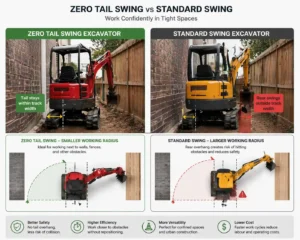
Manufacturers designed compact excavators with zero tail swing (ZTS) specifically for this scenario. The way it works is simple. The counterweight and upper structure rotate entirely within the machine’s own track width. No tail sweeping through the air behind you. No mental calculation about whether the rear is about to clip the neighbour’s fence. In spaces like these, the operator can run full swing cycles without stopping to reposition. That sounds like a small win. Multiply it by 200 cycles over an eight-hour shift and it becomes a real scheduling advantage.
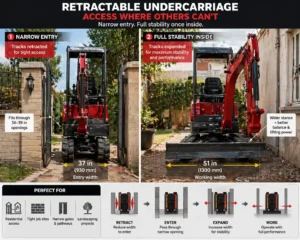
Some models take it further with retractable undercarriages. These compress the track width to as little as 37 inches for entry. Once inside the work area, the tracks expand back out to 51 inches for full stability. Think of it as the machine version of squeezing through a doorway. Once you’re in, you can breathe again.
Hydraulics: The Part Most Articles Skip Over (But Shouldn’t)
Here’s where the story gets more interesting. It’s also where most articles about mini excavators go quiet. Machine dimensions get most of the attention. But the hydraulic system decides how much work that machine actually does in a day.
Modern compact excavators run load-sensitive hydraulic systems. The pump output adjusts in real time based on what the machine is doing. On a confined site, an operator constantly manages boom lift, arm crowd, and swing at the same time. A load-sensitive system allocates hydraulic flow to each function proportionally. It doesn’t flood one and starve another. The result is smoother control, less wasted fuel, and an operator who stays in rhythm with the machine.
The attachment story follows from this. A compact excavator with a hydraulic quick coupler can switch between a trenching bucket, a hydraulic breaker, a compaction plate, and an auger in the same shift. No second machine needed. Fewer machines on a restricted access site means less congestion, fewer coordination headaches, and lower transport costs. Every one of those counts as an efficiency gain. Before the job, check one technical detail: does the excavator’s auxiliary flow rate (GPM) match each attachment’s minimum requirement? An attachment below its rated flow delivers below rated performance. It’s a fixable problem. Somehow it still surprises people on site.
The Crew Productivity Math Nobody Puts in Writing
When a compact excavator can get in but a full-size machine cannot, the usual fallback is hand excavation. That means a two- or three-person crew with spades, mattocks, and a whole lot of patience. The productivity gap is real and worth stating plainly. A 1.5- to 3-tonne mini excavator moves 40 to 90 cubic metres of material per day in typical soil conditions. A two-person hand-dig crew in the same conditions covers 8 to 12 cubic metres on a good day. Output drops further in the afternoon as fatigue sets in. The machine doesn’t get tired. It also doesn’t need a break to complain about the project manager’s timeline.
Beyond raw output, there’s the repositioning question. A swing boom lets the boom offset left or right. This means the operator can work along a foundation edge or utility trench without re-tracking the machine. Experienced operators plan their position to maximise what they can reach from a single stance. It’s almost like a chess move. Each unnecessary track movement is time not spent digging. Reducing repositioning frequency is one of the highest-leverage habits on a confined site. It takes both good machine design and a skilled operator to pull it off.
Getting There and Getting Started: The Efficiency Gain Before Work Begins
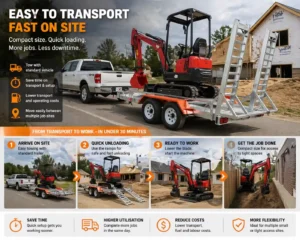
Efficiency on a tight access site doesn’t start at the dig face. It starts when the machine leaves the yard. A compact excavator in the 1- to 6-tonne class travels to site on a standard tandem trailer behind a pickup truck. It unloads in minutes and starts work within half an hour of arrival. No oversize load permits, no pilot vehicles, no three-hour setup sequence. A full-size excavator needs specialised transport, site access arrangements, and boom assembly. On a short job, that lead time can swallow a good chunk of the project day.
Some projects involve multiple tight-access locations in a single week — utility repairs, backyard drainage, phased foundation work across several lots. For those jobs, transport flexibility becomes a genuine schedule multiplier. The machine that arrives, works, and clears out quickly fits more jobs into a week. That’s not a minor convenience. Over a project season, it’s a meaningful difference in utilisation rate.
FAQ: What Site Engineers and Contractors Actually Ask
Can a mini excavator fit through a standard gate?
Most standard residential gates sit between 36 and 48 inches wide. Compact excavators with retractable undercarriages compress to 37–39 inches. That’s narrow enough to pass through a standard 36-inch opening when you align the machine straight to the entry. Before assuming access is clear, measure at ground level. Hinges, posts, and hardware often reduce actual clearance by 2 to 3 inches from the stated gate width.
When does zero tail swing matter most — and when is it less critical?
Go with zero tail swing when the machine regularly works within 18 inches of a wall or structure. If the site gives 24 inches or more of clearance during rotation, a reduced tail swing model is worth considering. These machines extend the counterweight 4 to 8 inches beyond the track width. In return, they offer slightly higher lift capacity within the same weight class. For most urban construction and confined utility work, a true ZTS delivers more daily value. The slight lifting edge of a reduced swing model rarely compensates for the extra repositioning.
Compact excavators improve efficiency on tight access sites because every design element targets the same constraint: doing meaningful work in a very small space. Geometry, hydraulics, weight class, and transport profile all point in the same direction. The best machines for these sites aren’t the most powerful on paper. They’re the ones that lose the fewest minutes to repositioning and logistics. They also prevent the kind of problems that only appear when the wrong equipment shows up. Choosing the right compact excavator is a technical decision. The parameters that matter most are the ones that match the geometry and workflow of the specific job in front of you.