
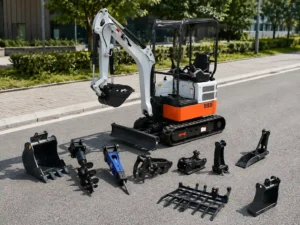
Mini excavator attachment compatibility is one of those topics that looks simple until the new attachment arrives, sits beside the machine, and refuses to fit like a stubborn pair of boots. A bucket, auger, breaker, thumb, grapple or compaction attachment may look right in a photo, but real compatibility depends on measurements, hydraulic capacity, machine weight and safe working balance. This guide explains what contractors, dealers, rental companies and equipment buyers should check before ordering an attachment for a mini excavator.
The goal is not to make the process sound difficult. In fact, a good compatibility check makes buying easier. Once you know which numbers matter, you can avoid wrong brackets, weak hydraulic performance, loose pins, unstable operation and those expensive “we thought it would fit” moments. A mini excavator is a very useful machine, but it is still a compact carrier. The attachment must match the machine, not argue with it all day on site. If you are comparing different mini excavator accessories, this checklist will help you ask better questions before confirming an order.
What Does Mini Excavator Attachment Compatibility Mean?
Mini excavator attachment compatibility means the attachment can be mounted correctly, powered properly and used safely under real working conditions. It is not enough for the attachment to “nearly fit” the machine. Even a nearly correct pin size can still create movement, while a nearly suitable hydraulic flow can make a breaker weak or an auger slow. Once the attachment weight is close to the machine’s practical limit, the excavator may also feel nose-heavy when the arm is extended.
For practical buying, compatibility should be checked in four areas: mechanical fit, quick coupler match, hydraulic requirements and working stability. These four checks belong together. A bucket may fit the pins but still be too heavy for the excavator. Hydraulic breakers can connect to the hoses and still need more flow than the machine can supply. Quick couplers save changeover time, yet they also add weight and slightly change the working position of the tool. Good buyers check the full picture before they spend money.
Quick Answer: Do All Mini Excavator Attachments Fit All Brands?
No, mini excavator attachments do not fit all brands automatically. Even machines in the same weight class may have different pin diameters, pin centre distances, dipper arm widths, coupler systems and hydraulic specifications. This is why “suitable for 1.5-ton excavators” or “fits most mini diggers” should be treated as a starting point, not a final answer.
For a reliable answer, ask for the actual mounting dimensions and hydraulic data. The supplier should confirm pin diameter, pin centre distance, ear gap, quick coupler type, attachment weight, hydraulic flow range and pressure range. When any of these details are missing, compatibility has not been fully confirmed. That may sound strict, but it is much cheaper than discovering the problem when the truck has already delivered the attachment.
Start with the Machine: Weight, Power and Working Task
Before checking the attachment, check the excavator itself. The machine’s operating weight tells you how much carrier is available to control the tool. Heavier machines can usually handle larger attachments with better stability, while lighter machines need more careful matching. This matters most with breakers, grapples, hydraulic thumbs, tilt buckets and compaction attachments, because these tools add weight at the end of the arm.
The working task is just as important as the machine size. A landscaper may need a grading bucket, auger and thumb for soil shaping, tree planting and material handling. Trenching contractors often care more about narrow buckets, quick couplers and compaction attachments. Demolition teams usually focus on breaker compatibility, hydraulic flow, hose protection and spare chisels. When buyers compare ACE mini excavator models, they should consider not only engine power and bucket capacity, but also which attachments the machine will use most often. The right attachment is not the biggest one in the catalogue; it is the one that suits the machine, the site and the operator’s daily work.
Check the Pin Size Before Anything Else
Pin size is the first hard measurement in any mini excavator attachment compatibility checklist. For a pin-on attachment, three dimensions matter most: pin diameter, pin centre distance and dipper arm width. Measure these dimensions carefully in millimetres. A few millimetres may not sound dramatic, but steel parts under digging force do not forgive poor measuring. They are not known for their soft personality.
Pin Diameter
Pin diameter is the thickness of the pin that passes through the attachment bracket and the excavator linkage or coupler. If the pin is too large, the attachment will not install. A pin that is too small may fit loosely, which creates knocking, vibration and faster bushing wear. Loose pins also make grading and trenching less accurate because the cutting edge responds late to the operator’s control movement.
Pin Centre Distance
Pin centre distance is the measurement from the centre of one pin hole to the centre of the other. This dimension affects whether the attachment can be picked up and how it moves through the working range. When the distance is wrong, the bucket or tool may not curl properly, may lose digging angle, or may hit the coupler or linkage during movement. Poor mounting geometry can waste power even before the attachment touches the ground.
Dipper Arm Width and Ear Gap
Dipper arm width, also called stick width or ear gap, is the space between the mounting ears. If the gap is too narrow, the arm or coupler will not enter the bracket. When the gap is too wide, the attachment may need spacers. Spacers are not a problem when they are correctly made and fitted, but random washers and hopeful thinking are not a proper engineering solution. Poor side alignment causes uneven wear and can make the attachment feel loose during operation.
Confirm the Mini Excavator Attachment Quick Coupler
A mini excavator attachment quick coupler can save a lot of time, especially for contractors and rental fleets that change between buckets, breakers, augers and grapples during the same day. Its main advantage is simple: when changing tools is easy, operators are more likely to use the right tool instead of forcing the wrong one to do every job. A bucket is useful, but it should not be asked to live three different careers before lunch.
However, a quick coupler adds another compatibility step. The attachment must match the coupler, not only the excavator. Buyers should confirm the exact coupler type, pin pickup range, locking method, bracket width and safety lock. Pin grabber couplers, hydraulic quick couplers, mechanical quick hitches and S-type couplers may all require different bracket details. Similar appearance does not guarantee the same fit.
When checking a quick coupler, pay attention to both safety and geometry. The coupler must lock fully, hold the attachment securely and allow the tool to move through its working range without interference. It also adds weight and may move the attachment slightly farther from the arm. In most daily work, faster attachment changes are worth it, but the buyer should still include the coupler weight and working angle in the compatibility check.
Match Hydraulic Flow, Pressure and Return Line Requirements
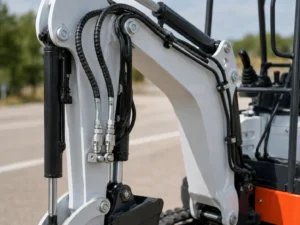
Hydraulic flow requirements become important when the attachment does more than sit on pins. Buckets are mainly mechanical tools, but breakers, augers, thumbs, grapples, tilt buckets, flail mowers and compaction attachments all depend on hydraulic power. Flow controls speed. Pressure controls force. Return flow controls how easily oil gets back to the machine. When these do not match, the attachment may be slow, weak, hot or noisy in a way that makes the operator stare at it with deep disappointment.
A hydraulic breaker needs stable flow and pressure within the recommended range. Too little flow makes it hit slowly and weakly. Excessive flow can overheat the tool, damage seals and shorten service life. An auger needs enough oil flow and pressure to produce torque without stalling in hard soil, clay or root-filled ground. Grapples and hydraulic thumbs need smooth control because the operator is holding logs, rocks or demolition waste, not squeezing a lemon.
Ask for the attachment’s required flow range, pressure range, maximum back pressure and hose coupling size before ordering. Then compare these figures with the excavator’s auxiliary hydraulic specification. Some attachments work with a standard two-way auxiliary circuit, while others may need a low-pressure return line or extra hydraulic function. Continuous-flow tools are especially sensitive to heat and back pressure, so the return path should not be ignored.
Check Mini Excavator Attachment Weight and Stability
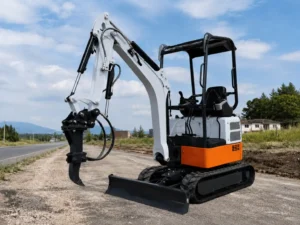
Mini excavator attachment weight affects stability, lifting capacity, fuel use, working speed and component wear. Because the attachment sits at the end of the arm, its weight has a stronger effect than the same weight placed close to the machine body. This is why a compact excavator can feel steady with a normal bucket but suddenly feel front-heavy with a large breaker, grapple or compaction plate.
This does not mean the lightest attachment is always better. Tools that are too light may wear quickly in rock, demolition debris or rental work. A better rule is to choose an attachment that is strong enough for the job but not heavier than the machine needs. A rock bucket may make sense in abrasive ground, but it is unnecessary weight for soft landscaping soil. If buyers are unsure how machine mass affects stability, lifting and attachment selection, this mini excavator weight guide is a useful supporting reference before making a purchasing decision.
When checking weight, include the coupler, attachment and expected load. A grapple carrying timber or concrete pieces adds load beyond its own steel weight. Also compare over-front and over-side working positions. Machines are usually more stable over the front with the blade down than over the side with the blade raised. Operators know this feeling very well; the machine tells them through the seat before the manual gets a chance.
Check Hose Routing and Hydraulic Couplers
Hydraulic hose routing is often missed during purchasing, but it matters on site. A hose may connect neatly when the machine is parked, then stretch, rub or twist when the boom rises, the arm crowds in, or the bucket curls fully. Before the attachment starts real work, the operator should move it slowly through the full working range and watch the hoses carefully.
The hydraulic couplers should match in type, pressure rating and size. Flat-face couplers are common on many compact machines because they help reduce oil loss and contamination during attachment changes. Whatever coupler style is used, clean both sides before connection. Dirt in a hydraulic line is not “just a little dust”; it is a small invitation for valve, seal and pump trouble.
For rental fleets, hose protection deserves extra attention. Different operators work close to walls, tree roots, broken concrete and trench edges. Hose sleeves, clamps, correct bend radius and protected service ports can prevent many early failures. A well-matched attachment with badly routed hoses is still a problem waiting for a busy Monday morning.
How to Install Mini Excavator Attachments Safely
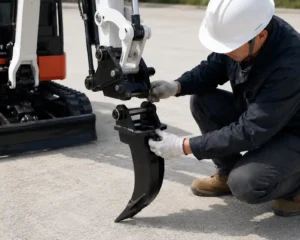
Knowing how to install mini excavator attachments safely is part of compatibility. A correct attachment can still become unsafe if it is fitted badly. Park the machine on firm, level ground, lower the current attachment, stop the machine and release hydraulic pressure before disconnecting hoses. Clean the couplers before connection, then connect the pressure and return lines according to the supplier’s instructions.
After mounting the new attachment, check that pins are fully seated, retaining clips are installed and the coupler is locked. If the machine uses a quick coupler, perform a low-height lock test before lifting or swinging the attachment. Then move the boom, arm and attachment slowly through the full range. Watch for hose tension, oil leaks, abnormal movement, metal contact and anything that makes the operator say, “That does not look right.” That sentence is often a useful early warning system.
The first test should be done in an open area, away from workers, vehicles, glass walls and customers who enjoy standing too close. Run the attachment at low speed first, then increase gradually once everything moves correctly. Treat the first few minutes as inspection time, not production time.
Attachment-Specific Compatibility Notes
Hydraulic Breaker Compatibility
A hydraulic breaker must match the excavator’s carrier weight, auxiliary flow, pressure and mounting bracket. Buyers should also check chisel size, hose size, spare seal availability and return line requirements. Choosing a breaker that is too large may look powerful, but it can overload the arm, heat the hydraulic oil and make the machine work harder than it should.
Auger Compatibility
A mini excavator auger attachment should be selected by hydraulic flow, torque, drilling diameter, drilling depth and soil condition. Soft soil, clay, roots and stones all behave differently. For fence posts, tree planting and light foundation holes, a correctly matched auger can save a lot of labour. When the auger is too large for the machine, it will stall often and turn a simple hole into a small outdoor drama.
Grapple and Thumb Compatibility
A grapple or thumb must match the machine, the bucket and the hydraulic circuit. Mechanical thumbs are simple and cost-friendly, while hydraulic thumbs give better control. Rotating grapples may need more hydraulic functions. Buyers should check opening width, clamping force, tine shape and lifting stability, especially when handling logs, rocks or demolition waste.
Compaction Attachment Compatibility
A mini excavator compaction attachment is useful for trench backfill, pipe bedding and narrow areas where a walk-behind compactor is inconvenient. The buyer should check hydraulic flow, attachment weight, plate size and vibration effect on nearby pipes, trench walls and structures. For contractors working on drainage, utility or narrow trench projects, this topic also connects naturally with choosing the right mini excavator for trenching work, because the machine and attachment must be selected as one working system rather than two separate purchases.
Mini Excavator Attachment Compatibility Checklist Before Buying
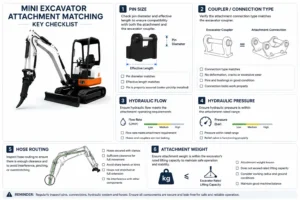
- Confirm the excavator model, operating weight and working task.
- Measure pin diameter, pin centre distance and dipper arm width.
- Confirm whether the attachment is pin-on or quick-coupler mounted.
- Check the exact mini excavator attachment quick coupler type.
- Compare attachment weight with machine stability and lifting limits.
- Check hydraulic flow, working pressure and back pressure requirements.
- Confirm hose size, coupling type and hose routing.
- Ask whether the attachment needs one-way flow, two-way flow or case drain.
- Check whether bushes, spacers or adapter plates are required.
- Confirm spare parts availability for pins, bushes, hoses, seals and wear parts.
- Test the attachment through the full movement range before starting work.
Common Buying Mistakes to Avoid
The first mistake is buying by machine tonnage only. A label such as “for 1.5 to 2 ton excavators” is useful, but it does not confirm pin dimensions, coupler type, hydraulic flow or working stability. It tells you the attachment may be in the right family, not that it is ready to come home for dinner.
The second mistake is ignoring attachment weight. A stronger tool is useful only when the excavator can handle it safely. Too much weight reduces lift capacity, slows movement and increases stress on pins, bushes and the boom. Another common mistake is treating hydraulic flow as a flexible number. Hydraulic attachments have working ranges for a reason. If the excavator cannot provide the right flow and pressure, the attachment will not perform as expected.
The fourth mistake is forgetting the operator. If attachment changes are slow, awkward or unsafe, operators may keep using the wrong tool simply because it is already fitted. A suitable quick coupler, clean hose layout and clear inspection routine can improve productivity more than adding another unused tool to the yard.
FAQ: Mini Excavator Attachment Compatibility
What attachments can a mini excavator use?
A mini excavator can use digging buckets, grading buckets, trenching buckets, hydraulic breakers, augers, thumbs, grapples, rippers, tilt buckets, quick couplers and compaction attachments, depending on the machine’s mounting dimensions, hydraulic capacity and safe operating weight range.
Do all mini excavator attachments fit all brands?
No, mini excavator attachments do not fit all brands automatically. Buyers need to check pin diameter, pin centre distance, dipper arm width, coupler type, hydraulic flow, pressure, hose connections and attachment weight before confirming compatibility.
How do I know if an attachment fits my mini excavator?
Measure the existing attachment or machine linkage, confirm the coupler type, compare hydraulic requirements with the excavator specification, and check attachment weight against the machine’s stability and lifting capacity. If one part is uncertain, ask the supplier for written confirmation.
What hydraulic flow do mini excavator attachments need?
The required hydraulic flow depends on the attachment. Breakers, augers, grapples, thumbs, flail mowers and compaction plates all have different flow and pressure ranges. Always compare the attachment specification with the excavator’s auxiliary hydraulic data.
Can I use an adapter plate for another brand’s attachment?
Yes, an adapter plate can help in some cases, but it must be correctly made. It may change attachment position, add weight and affect digging angle or stability. The supplier or technician should confirm the adapter before use.
Why does mini excavator attachment weight matter?
Attachment weight affects stability, lifting capacity, digging response, fuel use and wear on pins and bushes. The effect becomes stronger because the attachment works at the end of the arm, away from the machine body.
Final Buying Advice
A good mini excavator attachment compatibility checklist protects the buyer before the attachment reaches the site. Mechanical fit, hydraulic performance, safe weight and correct installation should be checked together. When these details are clear, the machine works more smoothly, the attachment lasts longer and the operator spends less time fighting equipment that should have been matched properly from the start.
For contractors, this means fewer delays. Dealers get fewer returns and clearer after-sales communication. Rental companies gain better utilisation and less damage from mismatched tools. If you are preparing an order, send your excavator model, pin diameter, pin centre distance, dipper arm width and hydraulic specifications to ACE Machinery so the attachment match can be checked before quotation. A mini excavator becomes far more useful with the right attachments, but compatibility is what turns those attachments from expensive steel into productive equipment.
If the attachment is a hydraulic breaker, confirm more than pin size. Use this mini excavator hydraulic breaker oil flow guide to check flow, pressure and carrier weight before ordering.