
Choosing a mini excavator auger by hole diameter alone is a bit like choosing a truck by tyre size. The number matters, but it does not tell you whether the machine can actually do the job.
A 300 mm auger in soft topsoil may run comfortably on a compact machine. Put the same auger into dry clay or shale and the result can be very different. Hydraulic flow, pressure, drive torque, machine weight and soil resistance all begin to matter. Buyers comparing different mini excavator attachments should therefore treat the auger, hydraulic circuit and carrier as one working system rather than three separate components.
For ACE Machinery buyers, the useful rule is simple: the right mini excavator auger size is not the largest bit that fits. It is the largest bit the carrier can run repeatedly in the actual ground without exceeding its hydraulic and stability limits.
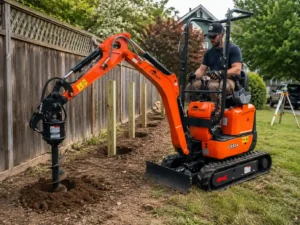
What Size Auger Can a Mini Excavator Run?
There is no universal rule such as “1-ton excavator = 300 mm auger.” Manufacturer data shows why. Compact auger systems for sub-3-ton excavators cover a broad range of bit diameters, but the usable limit depends heavily on the drive, hydraulic system and soil.
Digga, for example, lists its 1DSS auger drive for 0.75–3 ton mini excavators with a recommended hydraulic flow of 6–16 gpm. The same drive is rated for holes up to 24 inches in ordinary earth, but only 12 inches in clay or shale. That is a 50% reduction in recommended maximum diameter even though the excavator and drive have not changed. Source: Digga 0.75–3 Ton Excavator Auger Drive Specifications.
That example explains an important point: machine tonnage gives you a starting range, not the final auger size. Contractors choosing an earth auger drill for a mini excavator should check machine operating weight, continuous auxiliary hydraulic flow, working pressure, drive torque and actual soil condition before selecting the bit diameter.
The soil often decides whether a “possible” auger size becomes a productive one.
Hydraulic Flow, Pressure and Torque Are Not the Same Thing
One of the most common mistakes when choosing a mini excavator hydraulic auger is looking only at hydraulic flow. Flow matters because it influences motor speed, but flow alone does not tell you how much turning force the auger can produce.
Caterpillar’s A23 and A41 auger drives provide a useful comparison. Both are specified for an optimal hydraulic flow range of 42–83 L/min and a pressure range of 145–235 bar. The A23 produces about 2,304 N·m of maximum torque at up to 127 rpm, while the planetary-reduction A41 produces about 4,118 N·m at roughly 71 rpm. Source: Caterpillar A23 and A41 Auger Drive Specifications.
| Auger Drive | Hydraulic Flow | Pressure | Max. Torque | Max. Speed |
|---|---|---|---|---|
| Cat A23 | 42–83 L/min | 145–235 bar | 2,304 N·m | 127 rpm |
| Cat A41 | 42–83 L/min | 145–235 bar | 4,118 N·m | 71 rpm |
With essentially the same hydraulic input range, the A41 delivers roughly 79% more maximum torque while turning more slowly. The lesson is useful for any excavator brand: GPM or LPM alone does not define auger performance. Motor displacement, hydraulic pressure and gearbox reduction change what happens at the output shaft.
Fast rotation works well in easy soil. Torque becomes much more interesting when the auger meets clay, roots or rock.
Choose Auger Diameter by the Hole and the Ground
The job still starts with the required hole diameter. Bobcat currently lists auger bits across roughly 6 to 36 inches, covering work such as fence posts, tree planting, deck footings and utility installation. It also separates bit designs for ordinary soil, compacted material and harder rocky ground. Source: Bobcat Auger Buyer’s Guide.
But hole diameter should never be separated from soil type. Digga’s 1DSS example shows exactly why: the manufacturer’s maximum recommendation falls from 24 inches in ordinary earth to 12 inches in clay or shale. The drive did not suddenly become smaller. The cutting resistance became higher.
| Application | Main Selection Priority |
|---|---|
| Fence posts | Hole diameter, speed and repeatability |
| Tree planting | Wider hole and efficient spoil removal |
| Deck footings | Diameter and vertical accuracy |
| Loose soil | Efficient rotation and spoil clearance |
| Clay | Torque and clean-out ability |
| Rocky ground | Torque, teeth and bit construction |
| Hardpan or shale | Drive strength and cutting head design |
So when somebody asks, “What auger size should I buy?”, one of the most useful follow-up questions is simply: What are you drilling into?
Why an Oversized Auger Can Stall the Machine
As auger diameter increases, more material must be cut and moved during every revolution. Harder soil adds even more resistance. If the drive cannot produce enough torque, rotational speed drops and the bit can begin to stall.
Digga’s 1DSS drive produces up to 1,691 ft-lb of torque at 3,500 psi, yet the manufacturer still reduces its recommended maximum hole diameter from 24 inches in ordinary earth to 12 inches in clay or shale. Source: Digga 1DSS Technical Specifications.
This shows why the practical limit is not simply whether the bit can rotate. The real question is whether it can continue cutting productively under load. If the auger regularly works at the edge of the carrier’s hydraulic capability, drilling becomes slower, heat can rise and a small machine may struggle to resist reaction torque.
Contractors comparing machine size for regular drilling work should therefore check the excavator itself as carefully as the attachment. Our mini excavator buying guide explains how operating weight, auxiliary hydraulics and jobsite conditions affect machine selection beyond the attachment alone.
Attachment Weight and Mounting Matter Too
Hydraulics are only one part of compatibility. The auger drive adds weight to the end of the excavator arm before the bit and any material carried on it are considered.
Caterpillar’s A23 drive unit, for example, weighs about 90.3 kg, while a 2-ton excavator configuration with its mounting bracket is listed at approximately 117 kg. Source: Caterpillar Auger Drive Unit Specifications. On a compact carrier, that is enough mass to matter for handling and stability.
Before ordering a mini excavator auger attachment, confirm continuous auxiliary flow, working pressure, attachment weight, bracket dimensions, output shaft, hose connections and hydraulic couplers. ACE buyers can use the mini excavator attachment compatibility checklist to verify pin size, hydraulic flow and attachment weight before shipment.
A beautifully sized auger is still not very useful if the bracket does not fit or the hydraulic circuit cannot run the drive properly.
Mini Excavator Auger Size: A Practical Selection Checklist
| Question | What to Check |
|---|---|
| What hole diameter is required? | Post, tree, footing or utility dimensions |
| What soil will be drilled? | Sand, clay, gravel, rock or hardpan |
| What hydraulic flow is available? | Continuous L/min or GPM |
| What pressure is available? | Working bar or PSI |
| How much torque does the drive produce? | N·m or ft-lb at the required pressure |
| Can the excavator carry the attachment? | Drive, bracket, bit and working load |
| Does the mounting system fit? | Pins, bracket, couplers, hoses and shaft |
This is a more reliable way to select an earth drill than starting with diameter alone. Buyers looking at different carrier sizes can also compare ACE Machinery’s 1–3.8 ton mini excavator range before deciding which machine and auger combination best suits the job.
FAQ: Mini Excavator Auger Size
What size auger can a 1-ton mini excavator run?
There is no single fixed diameter. Manufacturer examples show that compact excavators can operate small-to-medium augers, but the real limit depends on hydraulic flow, pressure, drive torque and soil resistance. Harder ground can reduce the usable diameter substantially even when the machine and drive stay the same.
Can a mini excavator run a 12-inch auger?
In many configurations, yes. A 12-inch auger falls within the published capability of numerous compact excavator auger systems, but clay, shale and rocky ground may require considerably more torque and a different cutting-head design than the same diameter in loose soil.
How much hydraulic flow does a mini excavator auger need?
It depends on the drive. Digga’s 1DSS uses approximately 6–16 gpm, while Caterpillar’s A23 and A41 are specified for 42–83 L/min. The correct value is the attachment manufacturer’s operating flow range, not simply the highest auxiliary-flow figure printed in the excavator brochure.
Does a larger auger need more flow or more torque?
Both can matter, but torque becomes increasingly important as bit diameter and soil resistance rise. Caterpillar’s A23 and A41 demonstrate that two drives can use the same hydraulic flow range yet produce very different torque because their drive systems and reduction ratios are different.
Choose the Auger as a Complete System
The best mini excavator auger size is not just a diameter on a product page. Start with the hole and soil, then work backward through torque, hydraulic flow, pressure, carrier weight and mounting compatibility.
For ACE Machinery’s compact excavators, this approach is more useful than simply asking whether a machine can “run a 300 mm auger.” The better question is whether that machine can run the auger repeatedly in the actual soil, at the required hydraulic flow and torque, without turning every hole into a hydraulic argument.
If you are selecting an auger for contracting, landscaping, agricultural or dealer use, review ACE Machinery’s mini excavator attachment range or contact the ACE team with your excavator model, hydraulic flow, required hole diameter and soil condition so the attachment can be matched before ordering.