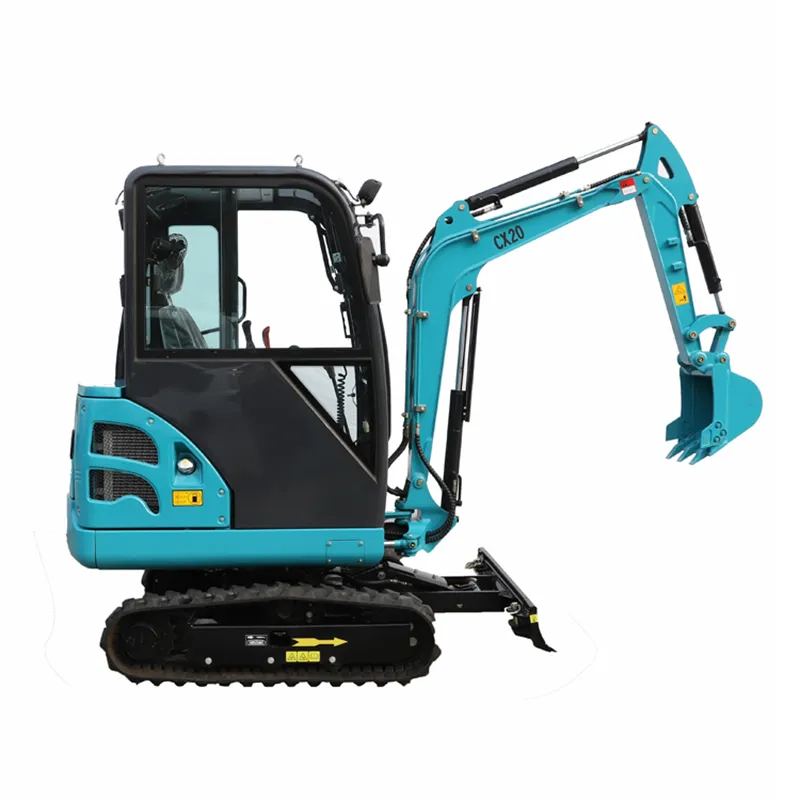

When buyers compare mini excavators, lower ground pressure often looks like an automatic advantage. A smaller PSI or kPa number should mean less sinking, fewer ruts and less damage to lawns or soft soil.
That is useful thinking, but it is not the whole engineering answer. Mini excavator ground pressure is a jobsite-matching parameter, not a simple machine quality score. Lower pressure is valuable on wet ground, loose fill and finished turf, while on firm construction sites the difference between two ground-pressure figures may matter much less than track width, traction, stability or undercarriage durability.
For buyers comparing compact excavators from ACE Machinery, the better approach is to look at ground pressure together with operating weight, track footprint, access width and actual soil conditions. A low number is helpful only when it solves a problem the jobsite actually has.
What Is Mini Excavator Ground Pressure?
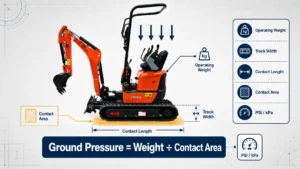
Ground pressure describes how much machine load is spread over the area of track touching the ground. A simplified calculation is:
Ground pressure = machine weight force ÷ total track contact area
For example, a 2,000 kg mini excavator produces roughly 19.6 kN of downward force. If its two tracks provide a combined contact area of 0.70 m², the average ground pressure is approximately 28 kPa, or about 4.1 psi.
The word “average” is important. The load underneath a rubber track is not perfectly uniform. Rollers, track tension, soil deformation and machine position create local pressure differences, so the figure published in a specification sheet is best used for comparing machine configurations rather than predicting the exact stress at every point underneath the track.
A real OEM example helps put the figure into context. Bobcat lists the E35z at approximately 3,362 kg operating weight, with 300 mm tracks and around 31.8 kPa ground pressure. That does not make 31.8 kPa a universal target. It simply shows why buyers should read the number together with machine size and intended application. Source: Bobcat.
Does a Heavier Mini Excavator Always Have Higher Ground Pressure?
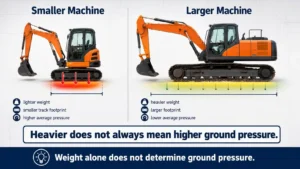
No. Kubota’s published specifications make this particularly clear. The K008-5 weighs about 2,315 lb and has a published ground contact pressure of 4.2 psi, while the larger KX018-4 weighs approximately 3,747 lb but is rated at only 3.7 psi. The larger machine is roughly 62% heavier, yet its average ground pressure is lower. Source: Kubota 2026 Full Product Line Brochure.
The explanation is simple: its weight is also spread over a larger track footprint. This gives buyers a useful rule: operating weight alone cannot predict mini excavator ground pressure. Track width and ground-contact length must be considered at the same time.
This is also why ground pressure should be separated from mini excavator stability on uneven ground. Weight influences both topics, but stability also depends on track gauge, center of gravity, boom position and working direction.
When Is Lower Ground Pressure Actually Better?
Lower ground pressure becomes especially valuable when flotation is the main problem. Wet clay, loose soil, agricultural land, landscaped areas and recently prepared ground are typical examples. A larger footprint spreads the machine load over more surface area and can reduce the tendency to sink deeply or create severe ruts.
On hard-packed gravel or a prepared construction pad, however, reducing an already reasonable ground-pressure figure may provide little practical benefit. In those conditions, access, digging performance, traction and durability may deserve more attention. That is why ACE Machinery treats ground pressure as part of a machine-to-jobsite matching decision, rather than a specification that should simply be pushed as low as possible.
A buyer should first ask: What is the weakest surface this excavator regularly needs to cross? That question is often more useful than asking which model has the smallest kPa value.
How Track Width Changes Ground Pressure and Access
Wider tracks generally increase contact area, which can reduce average ground pressure if machine weight stays similar. But a wider footprint comes with a very practical problem: the machine also needs to reach the job.
Kubota’s variable-width compact excavators provide a clear example. Its K008-5 is approximately 2 ft 4 in wide when retracted and around 2 ft 10 in when extended. The KX018-4 changes from roughly 3 ft 3 in to 4 ft 3.2 in. That difference matters on landscaping, residential and utility projects, where a few extra inches can decide whether a mini excavator fits through a gate. Source: Kubota.
For buyers using the ACE mini excavator buying guide, track width should therefore be checked together with working surface, transport limits, stability requirements and attachment use. The widest machine is not automatically the best machine. Snowshoes work very well in deep snow; they are considerably less useful in a narrow doorway.
Ground Pressure, Traction and Stability Are Different
| Parameter | What it mainly describes |
|---|---|
| Ground pressure | How machine load is spread over the ground |
| Traction | How effectively tracks transfer force into the surface |
| Stability | Resistance to tipping during operation |
| Flotation | Ability to remain on top of weak or soft ground |
Lower ground pressure can improve flotation, but it does not guarantee more traction. Likewise, a wide undercarriage may help stability, but actual stability still depends on center of gravity, boom position, blade position, working direction and slope. A single PSI or kPa value cannot describe how the machine will dig, travel and lift under every working condition.
Track Choice Also Has a Cost
The undercarriage is not just a way to reduce ground pressure. It is also one of the more expensive systems on a tracked machine. Caterpillar states that the undercarriage typically represents an average of around 50% of a tracked machine’s owning and operating costs. The figure applies to tracked equipment generally, rather than specifically to every mini excavator, but the lesson is useful: buyers should not choose tracks based on flotation alone. Source: Caterpillar.
Ground conditions influence wear. Frequent turning on abrasive surfaces, poor track tension and unsuitable track configuration can all affect undercarriage life. For contractors, rental fleets and equipment dealers, that makes ground pressure and lifecycle cost part of the same buying decision.
Soil Protection Depends on More Than Machine Specifications
Even the best low-ground-pressure mini excavator cannot solve every ground problem by itself. A 2026 study published in the Journal of Terramechanics examined construction traffic over temporary access systems including a 0.5 m sand track, 0.3 m timber mattresses and 0.1 m composite mats. Compared with unprotected ground, these materials reduced measured soil stress by 21–77% at 0.2 m depth and by as much as 60% at 0.4 m depth. Source: Journal of Terramechanics.
For contractors, that is a useful reminder. If soil protection is critical, temporary mats, prepared travel routes and reducing repeated passes can sometimes have a greater effect than choosing between two excavators whose published ground pressures differ by only a few kPa.
A low-ground-pressure machine can still damage wet turf if the operator repeatedly pivots in one spot. The specification sheet cannot rescue every operating decision.
What Ground Pressure Is Best for Different Jobsites?
| Jobsite | Main concern | Practical choice |
|---|---|---|
| Finished lawn | Surface damage | Lower ground pressure |
| Wet clay or mud | Sinking | Larger footprint |
| Agricultural soil | Compaction | Pressure + soil moisture |
| Loose fill | Flotation | Lower pressure often helps |
| Firm gravel | Productivity | Lowest kPa less important |
| Narrow access | Machine width | Compact/retractable configuration |
| Abrasive ground | Track wear | Durability and maintenance |
For overseas buyers, the most useful approach is not to request “the lowest ground pressure mini excavator.” Instead, provide the manufacturer with the jobsite surface, access width, expected attachments and operating conditions. That gives the supplier enough information to recommend the right machine configuration rather than simply the most attractive number in a brochure.
FAQ: Mini Excavator Ground Pressure
What is a good ground pressure for a mini excavator?
There is no universal PSI or kPa target. Ground strength, moisture, operating weight, track footprint and application all affect whether a specific value is suitable.
Do wider tracks reduce mini excavator ground pressure?
Usually yes. Wider tracks increase contact area and can reduce average ground pressure, but they may also increase machine width and affect access.
Does a heavier mini excavator always have higher ground pressure?
No. Kubota’s K008-5 and KX018-4 provide a useful example: the heavier KX018-4 has lower published ground contact pressure because its weight is spread across a larger footprint.
Is lower ground pressure better for soft soil?
Usually. Lower pressure generally improves flotation and reduces sinking, although soil moisture, repeated passes, operator technique and site preparation still affect the final result.
How ACE Machinery Approaches Ground-Pressure Selection
For ACE Machinery, the useful question is not simply whether one compact excavator has a lower ground-pressure figure than another. The better comparison is machine weight + track footprint + access width + soil condition + application.
A landscaping contractor working on finished turf has different requirements from a dealer supplying machines for general construction, and a rental company may place more weight on undercarriage durability and versatility. That is why mini excavator specifications should be used to narrow the decision, not replace engineering judgement.
A 25 kPa mini excavator is not automatically better than a 30 kPa machine. It is better only when that lower ground pressure matches the ground, access and work the buyer actually needs to handle.
Explore ACE Machinery’s 1–3.8 ton mini excavator range or contact the ACE team with your jobsite width, soil condition and attachment requirements for a more practical machine recommendation.