
Skid Steer Loaders: The Complete 2026 Guide
Skid steer loaders are small machines with a very long to-do list. On one jobsite, they may move soil in the morning, carry pallets before lunch, sweep the yard in the afternoon and help with landscaping before the day ends. For a compact machine, that is a busy schedule. No wonder contractors, farms, rental companies, landscapers and road maintenance teams still rely on them in 2026.
But buying a skid steer loader is not as simple as choosing the machine with the biggest engine or the lowest price. That is usually how expensive mistakes begin. A loader should match the ground condition, the daily workload, the attachments, the lifting requirement and the operator’s maintenance habits. When these things fit together, the machine works like a reliable team member. When they do not, even a new machine can quickly become the one everyone tries not to use.
This guide explains skid steer loaders from a practical and technical point of view. We will look at cost, lifting capacity, attachments, hydraulic flow, operation, maintenance and the common question of whether a wheeled skid steer or a compact track loader is the better choice. The aim is simple: help you choose a machine that works well in real conditions, not just in a brochure.
What Makes a Skid Steer Loader So Useful?
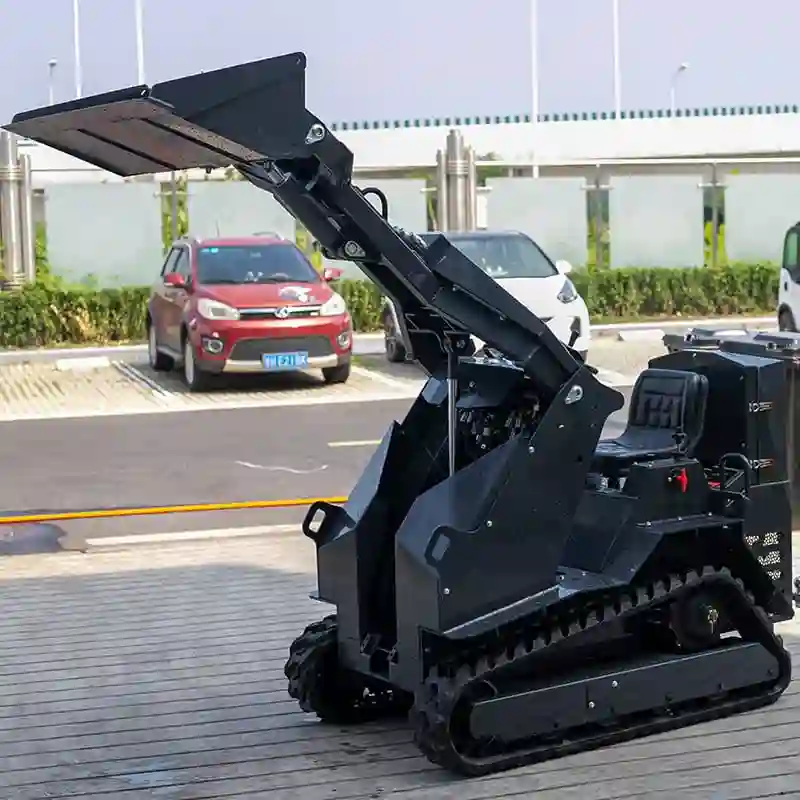
A skid steer loader is a compact construction machine with lift arms at the front and a quick-attach system for different tools. The bucket is the most common attachment, but it is only the beginning. With the right tools, the same machine can use pallet forks, augers, trenchers, sweepers, hydraulic breakers, grapples, levellers and many other attachments.
The machine gets its name from the way it turns. Instead of steering like a car, the wheels on each side can move at different speeds. This allows the loader to turn tightly, sometimes almost within its own length. On a crowded jobsite, this is not just convenient. It can be the difference between finishing the work smoothly and spending half the day saying, “Can someone move that pile?”
This tight turning ability makes skid steer loaders useful in narrow yards, farms, warehouses, road edges, residential construction sites and landscaping projects. A larger loader may move more material in open space, but it cannot always work comfortably in tight areas. A skid steer loader can move quickly between tasks, change attachments and work where larger machines would be too bulky.
If you want a deeper basic explanation of how the machine works and where it is commonly used, ACE also provides a helpful skid steer loader guide for uses, working principles and buying tips. It is a good supporting read before comparing specific models or attachment options.
However, versatility can also lead to poor buying decisions. Some buyers choose the loader first and think about attachments later. A better approach is to list the work first. If the machine will mainly handle soil, mulch and light grading, the requirements are different from a machine that must run a cold planer, hydraulic breaker or heavy trencher. The job should guide the machine choice, not the other way around.
Understanding the Real Cost of a Skid Steer Loader
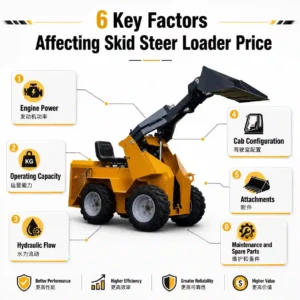
Many buyers start with one question: how much does a skid steer cost? It is a fair question, but the answer is rarely a single number. The final cost depends on machine size, engine power, rated operating capacity, hydraulic system, cab type, tyres, control system, emission standard, attachments, spare parts, warranty and shipping.
This is why looking only at the skid steer loader price can be misleading. A basic open-cab machine for light material handling will not cost the same as a larger model with an enclosed cab, air conditioning, high-flow hydraulics and several heavy attachments. More importantly, the cheaper machine may not be cheaper in the long run if it cannot do the required work efficiently.
For professional buyers, the better question is: what is the real cost per working hour? A machine that works smoothly, uses fuel reasonably, accepts the required attachments and avoids frequent downtime can be better value than a lower-priced loader that struggles every day. Price matters, of course. Nobody buys machinery with feelings alone. But price should be judged together with productivity, service life and maintenance cost.
This is also how to understand the phrase “best skid steer for the money in 2026.” It should not mean the cheapest loader on the market. It should mean the loader that gives the best balance between purchase cost, working ability, attachment compatibility, reliability and service support. A small landscaping company, a farm and a road maintenance team may all want good value, but they may not need the same machine.
Weight Capacity, Stability and Lifting Confidence
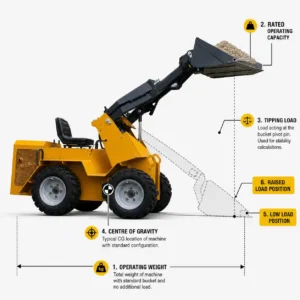
Horsepower often gets attention because it sounds impressive. But on a real jobsite, lifting capacity and stability may matter more. The machine must lift, carry and place materials safely. If it cannot handle the load with confidence, extra horsepower will not save the operator from trouble.
There are three important terms to understand: operating weight, rated operating capacity and tipping load. Operating weight is the weight of the machine itself. Rated operating capacity is the safe working load under defined conditions. Tipping load is the point where the machine may become unstable. In simple words, tipping load is the danger line, while rated operating capacity is the number you should respect during normal work.
This matters because materials are often heavier than they look. Wet soil, gravel, concrete waste, palletised blocks and feed bags can all surprise an operator. A bucket may look half full, but the machine feels the actual weight, not the operator’s optimism.
A heavier skid steer usually feels more stable and confident when lifting. However, it may require a stronger trailer and more careful transport planning. A lighter machine is easier to move and may suit smaller yards or sensitive surfaces, but it may not be ideal for heavy lifting. The right choice depends on the work. Landscaping jobs may need compact size and gentle ground behaviour, while construction material handling needs stronger lifting capacity and better front stability.
Skid Steer vs Track Loader: Choose by Ground Condition
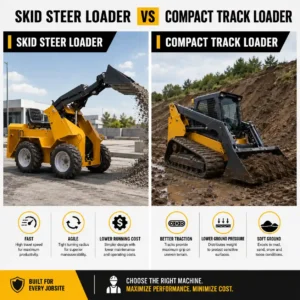
Many buyers compare a skid steer with a compact track loader before making a decision. The machines look similar, and many attachments can be shared, but they work differently on the ground.
A skid steer loader uses tyres. It is usually faster on hard surfaces, easier to maintain and more economical for jobs on concrete, asphalt, compacted soil, gravel yards and paved areas. Tyres are also simpler and less expensive to replace than a full track system. For many contractors who work mainly on firm ground, a wheeled skid steer is a practical and cost-effective choice.
A compact track loader uses rubber tracks. Tracks spread the machine weight over a larger contact area, giving better traction and lower ground pressure. This makes it stronger on soft, muddy, sandy, wet or uneven ground. It is also useful on slopes and on sites where ground disturbance must be reduced.
So the decision is not about which machine is better in every situation. Machines are not superheroes; they have working conditions. If your sites are mostly hard and stable, a skid steer loader is often the smarter choice. If your work often involves mud, soft soil, slopes or wet ground, a compact track loader may save time and reduce ground damage.
For landscaping, this comparison is especially important. A skid steer loader can be excellent for moving materials, levelling, grading and handling pallets on prepared surfaces. But if the job involves soft lawns, wet soil or delicate ground, tracks may protect the surface better. Choosing between the two should begin with the ground, not the catalogue photo.
Attachments Turn One Machine into Many Tools
The real value of a skid steer loader comes from its attachments. Without attachments, it is mainly a compact loader. With the right attachments, it becomes a digging machine, grading tool, lifting machine, sweeper, drilling unit, demolition helper or landscaping assistant.
A practical attachment setup should start with the jobs you do most often. A general bucket is useful for soil, gravel, sand and debris. Pallet forks are helpful for bricks, blocks, packaged materials and farm supplies. An auger is useful for fence posts, trees and foundation holes. A trencher helps with pipes, cables and drainage. A sweeper keeps yards, roads and factories clean. A grapple handles branches, logs, stones and demolition waste. A hydraulic breaker helps with concrete and light demolition.
| Application | Useful Attachments | Typical Work |
|---|---|---|
| Construction | Bucket, pallet forks, breaker, sweeper | Loading, lifting, breaking and cleaning |
| Landscaping | Auger, rake, leveller, soil conditioner | Planting, grading and soil preparation |
| Road maintenance | Sweeper, cold planer, breaker | Cleaning, milling and concrete removal |
| Farming | Bucket, forks, bale spear, grapple | Feed, manure, pallets and branches |
| Utility work | Trencher, auger, backhoe attachment | Pipes, cables, posts and drainage |
| Snow clearing | Snow blade, snow blower, angle broom | Winter road and yard work |
Before buying an attachment, check whether the machine can actually operate it well. The important points are hydraulic flow, hydraulic pressure, coupler type, machine weight, lifting capacity and visibility. A heavy attachment on a small loader may make the machine unstable. A hydraulic attachment on a machine with insufficient flow may move slowly, overheat or perform far below expectation.
For a skid steer loader used in landscaping, the most practical starting tools are usually a bucket, pallet forks, auger and levelling attachment. These cover most soil moving, planting, material handling and surface preparation work. For construction users, breakers, trenchers, sweepers and grapples may bring faster returns.
Standard Flow or High Flow Hydraulics?
Hydraulic flow is one of the most important technical details when choosing a skid steer loader, but it is also one of the easiest to misunderstand. Many buyers hear “high flow” and assume it is always better. In some cases, it is. In other cases, it is like buying a racing engine for a shopping trolley.
Standard flow hydraulics are enough for many common attachments. Buckets, pallet forks, grapples, many augers, light trenchers and some breakers can often work well with standard flow, depending on the attachment requirements.
High flow hydraulics are designed for tools that need more oil flow and continuous power. These may include cold planers, mulchers, stump grinders, heavy brush cutters and some high-performance trenchers. If the attachment needs strong hydraulic power for long periods, high flow can make a major difference.
However, flow is only one part of the system. Pressure, cooling capacity, hose size, coupler type and oil condition also matter. A loader may have enough flow on paper, but if the cooling system cannot handle long working hours, the hydraulic oil may overheat. When oil overheats, performance drops and component life suffers.
The practical rule is simple. If your main work uses buckets, forks, augers and lighter tools, standard flow may be enough. If your work depends on demanding hydraulic attachments, high flow is worth considering. The best choice is not the highest specification. It is the specification that matches the attachment.
How to Operate a Skid Steer Loader Safely
Operating a skid steer loader looks easy from the outside. Sit down, move the controls, lift the bucket and go. In reality, a skid steer is compact, powerful and quick to react. That combination is useful, but it also demands respect.
Before starting, the operator should walk around the machine and check the work area. Look for people, obstacles, soft ground, slopes, leaks, loose hoses and damaged attachments. Then enter the cab using three points of contact, fasten the seat belt, lower the safety bar if fitted and confirm that the controls are neutral.
For more beginner-friendly operating advice, you can also read this skid steer loader operation guide on controls, stability and safety. It is especially useful for new users who want to understand load handling, joystick response and safe movement before operating the machine on site.
During travel, keep the bucket or attachment low. A raised load moves the centre of gravity upward and forward, which reduces stability. This is especially risky when turning or travelling on uneven ground. A low load may not look dramatic, but safe operation is not a theatre performance.
Operators should also avoid sudden turns, sharp braking and aggressive spinning. Smooth control protects the machine, the attachment, the tyres and the ground surface. On slopes, drive carefully and avoid crossing the slope sideways if possible. If the ground feels unstable, slow down and lower the load.
Good operation is not about moving as fast as possible. It is about finishing the job without damage, panic or repair bills. The best operators make the work look simple because they control the machine before the machine controls them.
A Practical Maintenance Checklist
A good maintenance routine keeps a skid steer loader productive and prevents small issues from becoming expensive failures. Many serious problems begin quietly: a loose hose, low oil level, clogged radiator, weak battery, dirty filter or worn tyre.
Before daily work, check engine oil, hydraulic oil, coolant, fuel level, air filter condition, tyres, wheel nuts, hydraulic hoses, visible leaks, attachment locks, lights, alarms and safety devices. Also clear mud, stones, grass and dust from the cooling area. Skid steer loaders often work in dirty places, so cleaning is not about appearance. It is part of machine health.
Weekly maintenance should include greasing pivot points, checking cylinder pins, inspecting hydraulic couplers, checking battery terminals and looking for damaged hoses or uneven tyre wear. If the machine changes attachments often, the quick coupler needs special attention. Dirt around the coupler can enter the hydraulic system and damage pumps, valves or motors.
Service intervals should follow the manufacturer’s manual. Engine oil, hydraulic oil, filters and grease should be replaced or applied on schedule. Using the wrong oil or delaying service may seem harmless at first, but machines have long memories. They usually remind you later, with interest.
A skid steer loader maintenance checklist is not only for mechanics. Operators should understand it too. The person who uses the machine every day is often the first person to notice a new sound, vibration, leak or control change.
Common Problems: Starting, Controls, Noise and Vibration
Even a good machine can develop problems if it is used hard, maintained poorly or matched with the wrong attachment. Some of the most common issues include hard starting, failure to start, control problems, abnormal noise, excessive vibration and frequent repairs.
Hard starting may come from a weak battery, poor cable connection, clogged fuel filter, air in the fuel line, old fuel, blocked air filter, cold weather or starter motor problems. If you want a more detailed fault path, this article on why a skid steer is hard starting and how to find the real cause explains the issue through battery, fuel, glow plug and compression checks.
If the engine starts but loses power under load, check fuel supply, air intake, cooling condition and whether the hydraulic system is being overloaded. A machine that runs well at idle but struggles under load is often telling you that one support system cannot keep up once real work begins.
Control problems are not always caused by the joystick itself. The issue may come from a safety switch, wiring connector, sensor, controller, hydraulic valve or low hydraulic oil. A proper diagnosis should follow the control path step by step. Replacing random parts is not repair. It is guessing with a toolbox.
Abnormal noise deserves attention. A sharp hydraulic pump sound may suggest low oil level, blocked filters or air entering the system. Knocking may come from worn pins, loose bolts or damaged parts. Excessive vibration may be caused by tyre wear, wheel imbalance, engine misfire, loose mounts, worn bearings or an unbalanced attachment.
The best repair strategy is early action. Machines usually give warnings before they fail. Ignoring a new noise does not make the machine polite. It only gives the problem more time to become expensive.
How to Choose the Right Skid Steer Loader in 2026
Choosing the right skid steer loader starts with the work, not the brochure. The brochure tells you what the machine can do under ideal conditions. Your jobsite tells you what it must do every day.
The right skid steer loader also depends on where it will spend most of its working hours. For landscaping work, a compact body, clear visibility, smooth control and ground-friendly performance are often more valuable than maximum power. The machine needs to move soil, mulch, plants and paving materials without damaging the finished surface. For construction sites, the focus shifts to lifting capacity, structural durability, hydraulic power and attachment compatibility, because the loader may need to handle heavier materials, breakers, forks or trenchers every day. On farms, buyers usually care more about simple maintenance, strong tyres, easy service access and practical attachments for feed, manure, pallets or yard cleaning. For rental fleets, the priority is slightly different again: easy operation, reliable protection, simple servicing and a structure strong enough to survive different operators with very different driving habits.
A good buying sequence is straightforward. First define the daily tasks. Then list the attachments you need. After that, check hydraulic flow, lifting capacity, operating weight, ground condition, transport limits and service access. Only then should you compare prices.
If you are still at the early research stage, this basic introduction to what a skid steer loader is can support readers who need a simpler starting point before moving into advanced selection details.
This order helps avoid a common mistake: choosing a machine because the price looks attractive before checking whether it can do the work. A loader that matches your job will earn money. A loader that does not match your job will create excuses.
FAQ About Skid Steer Loaders
How much does a skid steer cost in 2026?
The cost depends on size, engine power, hydraulic system, cab type, attachments, warranty and shipping. Instead of looking only at the purchase price, buyers should calculate the real working cost, including maintenance, fuel, attachments and possible downtime.
Is a skid steer better than a compact track loader?
A skid steer is usually better on hard, stable surfaces because it is fast, agile and easier to maintain. A compact track loader is usually better on soft, muddy, wet or uneven ground because tracks provide better traction and lower ground pressure.
What attachments should I buy first?
Most users start with a bucket and pallet forks. Landscaping users may add an auger, rake or leveller. Construction users may add a breaker, sweeper, trencher or grapple, depending on the work.
Do I need high flow hydraulics?
You need high flow if you plan to use demanding hydraulic attachments such as mulchers, cold planers, stump grinders or heavy brush cutters. For buckets, forks, many augers and lighter tools, standard flow may be enough.
What should I check before operating a skid steer loader?
Check oil levels, coolant, fuel, tyres, hoses, leaks, attachment locks, safety devices and the work area. Keep the load low during travel and operate smoothly, especially on uneven ground or slopes.
Final Thoughts
A skid steer loader is not just a small machine with a bucket. It is a compact work system. Its value comes from the match between machine size, hydraulic power, attachments, ground condition, lifting capacity and maintenance habits.
In 2026, buyers have more choices than ever. That is good news, but it also means poor choices are easier to make. If you choose only by price, the machine may disappoint you. If you choose by real work requirements, it can become one of the most useful machines on your jobsite.
The smartest skid steer loader is not always the biggest, strongest or most expensive one. It is the one that fits your work so well that operators use it every day without complaining. In construction machinery, that is already a very good review.