
A quick hitch is meant to make life easier.
Instead of knocking out attachment pins every time you change from a bucket to a breaker or ripper, the hitch stays on the excavator and makes tool changes much quicker.
The problem is that “a quick hitch for a 1.8-tonne excavator” is not enough information to guarantee a good fit.
Two machines with almost the same operating weight can use different pin diameters, pin centres and mounting widths. Even if the hitch fits the excavator, your existing bucket may still use different pickup dimensions.
So before ordering a mini excavator quick hitch, start with the machine model and weight, then check the actual measurements.
A few minutes with a tape measure or caliper is much cheaper than discovering the mistake after the hitch has crossed an ocean.
What Size Quick Hitch Does My Mini Excavator Need?
Excavator weight is useful because it helps narrow down the right hitch class.
It is only the starting point, though.
| Check | Why it matters |
|---|---|
| Excavator model | Gives the supplier a clear starting reference |
| Operating weight | Helps narrow the hitch size |
| Pin diameter | Must match the machine linkage |
| Pin centre distance | Affects linkage geometry |
| Mounting width | Determines whether the hitch physically fits |
| Hitch type | Mechanical and hydraulic systems work differently |
| Hitch weight | Adds load at the end of the arm |
| Attachment dimensions | Buckets and tools still need to fit the hitch |
ACE’s current quick hitch for mini excavators is a useful example. The published version weighs about 20 kg, uses a 30 mm pin diameter and is listed for a 1.8-tonne mini excavator.
That does not mean every 1.8-tonne machine uses 30 mm pins.
It simply shows one real configuration. The final fit still depends on the actual machine dimensions.
How to Measure a Mini Excavator Quick Hitch
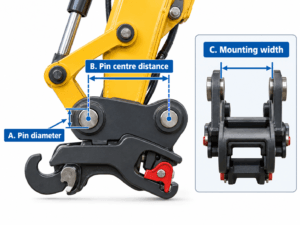
You do not need a workshop full of tools.
For most buyers, three measurements do most of the work.
Pin Diameter
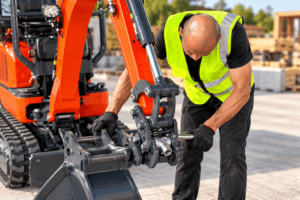
Pin diameter is simply the outside diameter of the attachment pin.
Measure it in millimetres. A vernier caliper is better than guessing with a tape measure, especially when a few millimetres decide whether the hitch fits or does not.
If the front and rear pins are different sizes, record both.
Do not assume two excavators in the same weight class use the same pins. Manufacturers have a habit of making that part interesting.
Pin Centre Distance
Pin centre distance means the distance from the centre of one pin to the centre of the other.
The word “centre” matters.
Measuring from the outside edge of one pin to the outside edge of the other can give you the wrong number, even if your tape measure is perfectly accurate.
This dimension affects how the hitch sits in the linkage and how the attachment moves through its working range.
Mounting Width
The supplier also needs the width of the area where the hitch connects to the excavator arm.
You may see this called mounting width, dipper width or ear width.
The name is less important than the measurement itself. The hitch needs to fit correctly without excessive side movement.
If you are unsure where to measure, send a clear photograph with the dimensions marked on it. One useful photo can save several rounds of emails.
For a broader explanation of these measurements, the mini excavator attachment compatibility checklist covers pin diameter, pin centres, mounting width and attachment fit in more detail.
ACE 30 mm Quick Hitch: A Real Example
The current ACE product gives buyers a practical reference:
| Item | ACE example |
|---|---|
| Suitable excavator class | 1.8 tonne |
| Pin diameter | 30 mm |
| Hitch weight | 20 kg |
| Typical attachment types | Bucket, breaker, ripper, auger |
ACE also lists quick hitches among the available attachments for the CX18 1.8-tonne mini excavator and the CX20T 2-tonne mini excavator.
These examples show that quick hitches are commonly used in the 1.5- to 2-tonne compact excavator range.
They do not prove that every machine in this class uses the same hitch.
The tape measure still gets the final vote.
Mechanical vs Hydraulic Quick Hitch
Once the dimensions are correct, the next question is usually whether to choose a mechanical or hydraulic hitch.
The main difference is how the locking system is operated.
Mechanical Quick Hitch
A mechanical hitch normally needs some manual action when the attachment is changed.
Depending on the design, the operator may need to leave the cab and use a locking pin or release tool.
For a machine that spends most of the day with the same bucket, that may not be a problem. The system is relatively simple and does not need hydraulic power to operate the hitch itself.
Hydraulic Quick Hitch
A hydraulic hitch uses hydraulic power to operate the locking mechanism.
On a compatible machine, this allows the operator to change attachments more quickly from the cab.
That becomes useful when a contractor regularly switches between a bucket, breaker, ripper or other tool during the day. Bobcat’s excavator coupler guidance also distinguishes mechanical and hydraulic systems by the amount of manual intervention needed during attachment changes.
| Item | Mechanical hitch | Hydraulic hitch |
|---|---|---|
| Attachment changes | More manual work | Faster on compatible systems |
| System complexity | Lower | Higher |
| Hydraulic operation | Usually not required | Required |
| Best suited to | Less frequent tool changes | Frequent attachment changes |
| Main check | Dimensions and locking method | Dimensions, hydraulics and locking system |
Neither type is automatically better.
If you change attachments twice a week, a mechanical hitch may be perfectly practical. If you change them six times before lunch, the hydraulic option starts to look much more appealing.
Remember That the Hitch Has Weight
A quick hitch stays between the excavator arm and the attachment.
That means its weight is always part of the working load.
The ACE example weighs about 20 kg. Add a bucket or breaker, then add whatever the attachment is carrying, and the total rises quickly.
This matters because weight at the end of the arm affects the machine more than the same weight sitting close to the excavator body.
A hitch can also move the attachment slightly farther away from the arm, depending on the design. That can change digging geometry and reduce some of the machine’s remaining lifting margin.
The mini excavator lifting capacity guide explains why attachment weight and working radius matter when judging what a small excavator can safely handle.
The hitch may save thirty seconds during an attachment change. It should not make the machine awkward for the next six hours.
Will My Existing Bucket Still Fit?
Possibly, but do not assume it will.
This is one of the most common mistakes when buying a quick hitch.
A hitch may fit the excavator correctly while an old bucket still does not fit the hitch.
Before ordering, check the pickup dimensions of the attachments you plan to keep using.
For buckets and rippers, this is mainly a mechanical fitment issue.
For hydraulic attachments such as breakers and augers, mechanical fit is only the first step. Oil flow, pressure and hose connections still need to match the machine.
A quick hitch does not make every attachment universal. It simply makes compatible attachments quicker to change.
If you are comparing several tools, the wider ACE mini excavator attachments range is a useful place to check available attachment types.
Quick Hitch Safety: Make Sure It Is Actually Locked
An attachment hanging from the hitch is not necessarily an attachment that is properly locked into it.
Different hitch designs use different locking systems, so operators should follow the procedure for the specific product being used.
The practical rule is easy to remember: Connect it, lock it, check it, then work.
If the manufacturer’s instructions require a visual or physical check of the locking system, do that before lifting the attachment into a normal working position.
This is not paperwork for the sake of paperwork. The UK Health and Safety Executive has documented serious quick-hitch incidents linked to retaining and locking failures. See the HSE quick hitch safety guidance.
What Should You Send Before Asking for a Quote?
A supplier can usually confirm fitment much faster if the enquiry includes real machine measurements.
| Information | Example |
|---|---|
| Excavator make and model | ACE CX18 |
| Operating weight | 1,780 kg |
| Front pin diameter | mm |
| Rear pin diameter | mm |
| Pin centre distance | mm |
| Mounting width | mm |
| Existing bucket dimensions | Measurements + photos |
| Preferred hitch type | Mechanical / hydraulic |
| Attachments to use | Bucket, breaker, auger, ripper |
| Quantity | Single unit, dealer or fleet order |
| Destination | Country / port |
“Need a quick hitch for a 1.8-tonne excavator” is enough to start the conversation.
The measurements are what allow the supplier to finish the job properly.
Buyers who already have these details can contact ACE Machinery for fitment checking and quotation support.
FAQ
Does a 30 mm quick hitch fit every 1.8-tonne mini excavator?
No. ACE has a 30 mm example for a 1.8-tonne machine, but pin centre distance, mounting width and attachment dimensions can vary between excavators.
How do I measure quick hitch pin centres?
Measure from the centre of one attachment pin to the centre of the other. Do not measure from outside edge to outside edge.
Which is better, mechanical or hydraulic?
A mechanical hitch is simpler and can suit machines that rarely change tools. A hydraulic hitch is more convenient where attachments are changed frequently. The better choice depends on the machine and working routine.
Will my old bucket fit a new quick hitch?
Not automatically. The hitch must fit the excavator, and the bucket must also match the hitch pickup dimensions.
Does a quick hitch affect lifting capacity?
Yes. It adds its own weight at the end of the arm and may increase the attachment offset. This can reduce the remaining lifting margin, depending on the machine, hitch, attachment and working position.
Measure First, Order Second
Choosing a mini excavator quick hitch does not need to be complicated.
Start with the excavator model and operating weight. Measure the pin diameter, pin centres and mounting width. Decide whether a mechanical or hydraulic system suits the way you work, then check the buckets and other attachments you plan to use.
ACE’s 20 kg, 30 mm quick hitch for a 1.8-tonne-class application is a useful reference, but the final fit should always be confirmed from the actual machine dimensions.
A quick hitch is designed to save time.
Spending a few minutes measuring it properly is a good way to make sure it actually does.