
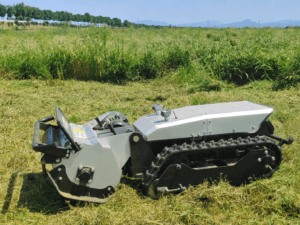
Ask several suppliers for a remote control mower quotation and the numbers can be surprisingly far apart. That does not automatically mean one supplier is expensive and another is cheap. Quite often, the machines are simply built for very different jobs.
A light mower for maintained grass is not the same machine as a tracked slope mower built for roadside vegetation, rough ground or repeated contractor use. A U.S. municipal tender for remote-controlled slope mowers showed this clearly: the highest bid was about 81% above the lowest bid, while quotations for replacement track sets varied by more than two times between machines. The products were not identical, but that is exactly the point—professional buyers need to compare the complete specification and support package, not one number at the bottom of a quotation. Source: City of Lewiston public procurement.
A useful remote control lawn mower price comparison therefore starts with one question: what are you actually buying?
What Makes One Remote Control Mower Cost More Than Another?
The chassis is one of the first differences.
Tracked machines add crawler assemblies, drive components and more undercarriage hardware, but that extra equipment has a reason to exist. It becomes useful when the mower has to work across slopes, soft soil, rough vegetation or uneven ground where a simple wheeled platform may struggle.
The ACE GT-LD1200 remote control tracked lawn mower, for example, uses a crawler chassis with a 1,000/1,200 mm maximum grass-cutting width, climbing capability below 45°, and remote operation up to 200 m. It also supports more than mowing, including tilling, trenching and other agricultural work. Those features add complexity, but they also mean one machine can cover jobs that would otherwise need several pieces of equipment.
Cutting system matters just as much. A flail deck uses many individual flails on a rotating rotor, while other grass-cutting systems use different blade arrangements. For rough vegetation, weeds and mixed growth, the flail system may justify the additional wear parts. For maintained grass, that complexity may not be necessary.
Buyers who are still deciding between cutting systems should handle that question separately in the flail mower vs rotary mower guide rather than choosing only by purchase cost.
| Cost factor | Why it changes the machine | What the buyer should check |
|---|---|---|
| Tracked chassis | More drive and undercarriage components | Slope, soil and ground condition |
| Cutting system | Different rotor, blade and wear-part design | Grass, weeds or rough vegetation |
| Working width | Changes productivity and machine size | Access width and daily area |
| Power system | Battery, gasoline and hybrid layouts differ | Working hours and charging/fuel access |
| Remote system | Adds radio controls and safety functions | Working distance and fail-safe design |
| Spare parts | Changes long-term ownership cost | Blades, belts, tracks and service stock |
Bigger Specifications Do Not Always Mean Better Value
It is easy to compare two mower brochures and start circling the largest number in every row.
That usually leads to an expensive machine.
Working width is a good example. Agria rates its 90 cm 9500-90 at up to 3,500 m²/h at 5 km/h, with a published slope capability of 50° and an operating weight of about 412 kg. The machine also has a maximum radio range of 300 m, but Agria recommends a maximum working range of 100 m. Source: Agria 9500-90 official specifications.
That last detail is useful. The biggest number on a specification sheet is not always the number the operator should plan around.
The same applies to slope ratings. A mower that can technically climb a steep grade still needs enough traction, a suitable cutting system and a safe operating route. If most of the work is flat orchard grass, paying for extreme slope capability may be rather like buying mountain boots to walk around the office.
Machine Price and Landed Cost Are Two Different Numbers
For overseas buyers, the machine quotation is only the beginning.
The trade term matters because it determines where cost and risk move from seller to buyer. Under Incoterms® 2020, EXW places most transport responsibility on the buyer from the seller’s premises. FOB transfers risk once the goods are on board the vessel, although ICC notes that FCA is generally more suitable when containerized cargo is handed to a carrier before vessel loading. CIF includes main carriage and minimum insurance to the named destination port. Source: ICC Incoterms® 2020 checklist.
A practical landed-cost calculation should include:
Machine + options + spare parts + export packing + inland transport + international freight + insurance + customs/tax + port charges + final delivery
This is especially important with tracked machines because wear parts are not free after the mower arrives. In one municipal procurement, quotations for replacement track sets differed by more than 2.2 times depending on the machine, and bogie-wheel packages also varied substantially. Source: City of Lewiston public procurement.
A cheaper mower can stop looking cheap very quickly if common parts need emergency international shipping.
Cost Depends on Where the Mower Will Work
A farm, an orchard and a roadside embankment may all need grass cutting, but they do not need the same machine.
For farms and orchards, width, turning room and the distance between rows can matter more than maximum slope rating. For roadside and embankment work, keeping the operator away from steep ground and traffic becomes much more important.
Caltrans has tested remote-controlled mowers in real roadside conditions. Its research found effective mowing rates of roughly 0.25–0.5 acre per hour. In one timed test, a machine covered 0.16 acre in 19 minutes, equivalent to about 0.51 acre per hour. In a more difficult landscaped interchange with trees and repeated direction changes, output dropped to about 0.25 acre per hour. Source: Caltrans remote-controlled mower field research.
That is a useful reminder for buyers: brochure productivity and real jobsite productivity are not the same thing.
Caltrans also found that remote mowers had clear value where slopes and confined areas made conventional mowing or manual trimming difficult, even though using them on the steep portion of an average interchange was estimated to increase mowing cost by about 30%. Source: Caltrans research summary.
So remote control is not automatically the cheapest answer. Sometimes it is the safer or more practical answer.
That distinction matters.
How to Think About Remote Control Mower ROI
ROI should start with your own work records, not a sales brochure.
Take the number of mowing days per year, multiply by crew size and labor hours, then add fuel or electricity, transport, wear parts, maintenance and financing. Compare that with the expected output and ownership cost of the mower.
For example:
Annual labor exposure = crew size × hours per job × jobs per year × local labor cost
Then ask a harder question:
How many of those labor hours can the mower genuinely replace?
Do not assume 100%.
Caltrans’ field tests show why. A remote mower might cover around 0.5 acre/h in one open area but only 0.25 acre/h where trees and obstacles force repeated turns. Source: Caltrans field test.
That difference can completely change the payback calculation.
Remote mowing can also create value that is harder to show in a simple spreadsheet. Caltrans reported reduced personnel exposure to roadside traffic, steep embankments and rollover hazards as important benefits of remote-controlled mowing. Source: Caltrans Mile Marker.
For contractors, municipalities and rental fleets, those factors belong in the decision even when they do not fit neatly into a “cost per acre” cell.
What Should You Send Before Asking for a Quote?
The quickest way to get a poor quotation is to send a supplier:
“Need remote mower. Best price?”
There is not much engineering hiding in that sentence.
Send the working conditions instead.
| Buyer information | What to provide |
|---|---|
| Terrain | Flat, uneven, muddy, orchard or roadside |
| Maximum slope | Measured angle or grade |
| Vegetation | Grass, tall weeds, rough growth or light brush |
| Access | Narrowest gate, row or transport width |
| Working area | Approximate area per day |
| Power preference | Electric, gasoline or other |
| Quantity | One machine, contractor fleet or dealer order |
| Destination | Country and destination port |
| Spare parts | Blades, belts, tracks, filters, batteries as applicable |
If the main problem is still choosing the machine type rather than calculating cost, use ACE’s remote control lawn mower selection guide first.
For steep-ground work, the remote control slope mower safety checklist should also be part of the buying process.
FAQ
Why do remote control lawn mower prices vary so much?
Because “remote mower” covers very different machines. Chassis type, cutting system, working width, power system, slope capability, radio controls, safety systems and spare-parts support can all change the final configuration.
Is a tracked remote control mower always worth the extra cost?
No. Tracks make sense when terrain, slope or ground condition needs them. On firm, simple ground, a lighter machine may do the same job with less complexity.
Does a wider mower always give better ROI?
No. Wider decks can improve theoretical area output, but access, turning, vegetation density and terrain can reduce real productivity. Caltrans tests showed field mowing rates changing from about 0.25 to 0.5 acre/h depending on conditions.
What matters most for overseas buyers besides the machine quotation?
Trade terms, freight, insurance, customs, destination charges, spare parts, service support and final delivery all belong in the landed-cost calculation.
Should I compare remote mowers by slope rating?
Slope capability matters, but it should be considered together with traction, machine weight, cutting system, operating procedure and the actual site. A large slope number by itself is not a buying decision.
The Cheapest Quote Is Not Always the Cheapest Machine
A remote control mower earns its money when it fits the job.
If the terrain is steep, the machine needs traction and safe remote operation. If the work is open and flat, productivity may matter more. If the mower is being imported, freight and spare parts matter. If it will work every week, downtime matters even more.
The useful question is not:
“What is the cheapest remote control lawn mower?”
It is:
“What will this machine cost to own, keep working and use on my actual site?”
That is the number worth comparing.
For model matching, the full ACE range is available in the remote control lawn mowers category. Buyers can then provide slope, vegetation type, working width, annual workload and destination details before requesting a quotation.