
Tracked Dumper vs Wheeled Dumper: Which Mini Dumper Is Better for Your Jobsite?
Choosing between a tracked dumper and a wheeled dumper sounds simple until the machine is fully loaded, the ground turns soft, and the operator realizes the “short shortcut” across the site is actually a mud bath wearing a hard hat. Both machines can move soil, gravel, sand, bricks, demolition waste and farm materials, but they do not put their weight on the ground in the same way. That difference affects traction, rutting, speed, maintenance cost and safety.
For most jobs, the rule is practical: choose a tracked dumper when the route is soft, muddy, sloped, narrow or unfinished; choose a wheeled dumper when the route is firm, flat and long enough for travel speed to matter. The best mini dumper is not the one that looks strongest in a brochure. It is the one that can finish repeated loaded trips without getting stuck, damaging the surface or turning daily maintenance into a second job.
Tracked Dumper vs Wheeled Dumper: Quick Answer
If your jobsite has mud, wet clay, loose soil, slopes, orchards, landscaping areas or unfinished access roads, a tracked dumper usually gives better control. If your site has concrete, asphalt, compacted gravel or a prepared haul road, a wheeled dumper is usually faster and cheaper to run. Caterpillar’s equipment selection data shows why this split exists: wheel machines can travel up to three times faster than comparable track machines on suitable ground, while tracked machines typically operate with much lower ground pressure.
| Decision Factor | Tracked Dumper | Wheeled Dumper |
|---|---|---|
| Best ground | Soft soil, mud, slopes, wet grass, rough terrain | Concrete, asphalt, compacted gravel, dry firm routes |
| Ground pressure | Lower pressure because weight is spread across the track footprint | Higher pressure because weight is concentrated through tires |
| Travel speed | Slower, but more stable on poor ground | Faster on firm ground; Cat data notes wheels can be up to 3x faster than tracks |
| Traction | Better on loose, wet and uneven surfaces | Efficient on hard surfaces, weaker on soft ground |
| Maintenance focus | Track tension, rollers, sprockets, undercarriage cleaning | Tires, axles, hubs, steering and brakes |
| Best use case | Landscapers, farms, orchards, muddy construction sites, slope work | Contractors working on prepared surfaces and longer haul routes |
What Is a Tracked Dumper?
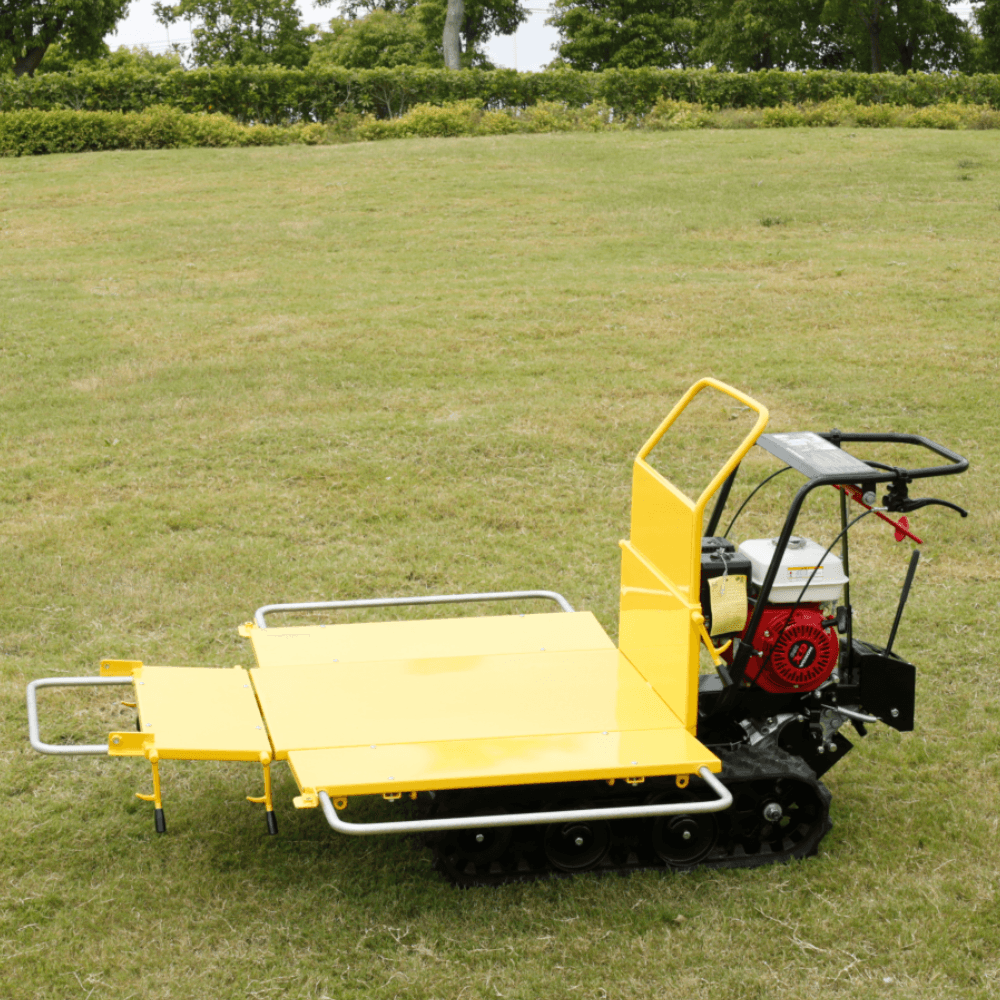
A tracked dumper is a mini dumper that runs on rubber or steel crawler tracks instead of tires. The tracks create a larger contact area with the ground, so the machine spreads its weight and payload over more surface. This helps the dumper keep moving where tires may sink, spin or cut deep ruts into the ground.
This is not just marketing talk. The Caterpillar Performance Handbook lists typical ground pressure for wheel machines at about 241-310 kPa, while track machines are listed at about 82-97 kPa in comparable machine-selection guidance. The exact number changes by machine size, load and track design, but the engineering point is clear: tracks normally reduce average ground pressure, which is why they are useful on weak surfaces.
What Is a Wheeled Dumper?
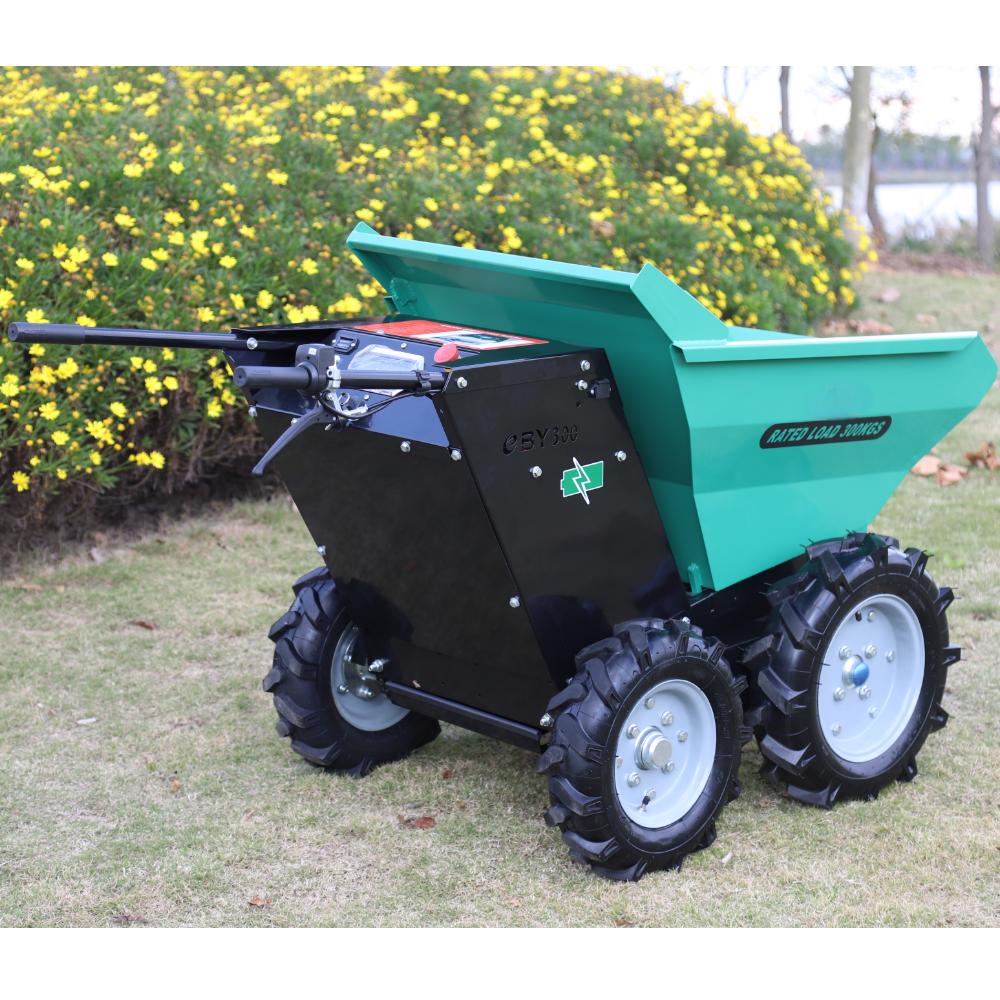
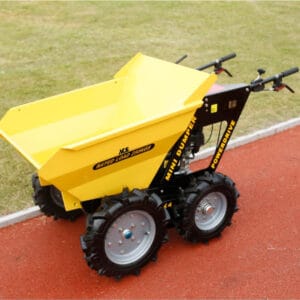
A wheeled dumper uses tires to carry and drive the machine. On firm ground, this is a big advantage. Tires have lower rolling resistance than tracks, so the dumper can move faster and waste less energy during repeated travel. If the job is moving material across a prepared route, a wheeled dumper often completes more trips per hour.
The weakness appears when the ground cannot support the loaded tires. A wheeled dumper that works beautifully on compacted gravel can become painfully slow on wet clay. Once the tires start cutting ruts, the operator is no longer saving time. The machine is now digging its own little trench, which is impressive, but not helpful.
The Real Difference Is Ground Pressure Under Load
Many buyers compare payload first, but payload is only half the story. A 500 kg rated dumper may look strong on paper, but the real question is how that loaded weight reaches the ground. In a soil-compaction study summarized by IntechOpen, tire undercarriage systems showed an average ground pressure of 107 kPa, while rubber tracks showed 84 kPa. That does not mean tracks are magic slippers for machines, but it does show why rubber tracks usually perform better when the surface is soft.
The practical lesson is simple. If the jobsite has wet soil, fresh fill, soft turf, orchard ground or loose construction spoil, lower ground pressure can keep the dumper moving with less surface damage. If the route is dry, hard and already compacted, the lower pressure advantage matters less, and the wheeled dumper’s speed advantage becomes more valuable.
When a Tracked Dumper Is the Better Choice
A tracked dumper is usually the better choice when the weakest section of the route controls the whole job. That weak section might be a muddy entrance, a slope behind a house, a narrow orchard row, a wet landscaping area or a pile of loose demolition material. In those places, traction and stability matter more than top speed.
Tracks also help when the operator needs predictable movement at low speed. This is useful when carrying loads near trenches, walls, fences, trees or soft edges. However, tracked dumpers are not maintenance-free. Mud should be cleaned from the undercarriage, track tension should be checked, and rollers or sprockets should not be ignored. A tracked dumper is excellent in bad ground, but it still likes a little respect at the end of the day.
When a Wheeled Dumper Is the Better Choice
A wheeled dumper is usually the better choice when the route is firm, open and repetitive. On concrete, asphalt, compacted stone or a dry prepared haul road, wheels are faster and simpler. This is why wheeled dumpers are common on building sites, paved yards, warehouse renovation projects and material-handling routes where the operator travels back and forth all day.
The cost advantage can also be real. Tires, hubs and brakes are generally easier to inspect than a crawler undercarriage, and a wheeled dumper is often easier to transport between jobs. But this advantage depends on the surface staying firm. If the site becomes wet and the wheels start spinning, the machine may lose both speed and efficiency. A wheeled dumper is a good runner, but it does not enjoy swimming.
Do Not Ignore Stability and Slope Risk
Traction is important, but it is not the same as safety. A machine can have enough grip to climb and still be unsafe if the load shifts, the slope changes direction, or the center of gravity moves outside a stable range. OSHA has treated dumper-type earthmoving equipment as rollover-risk equipment in construction guidance, especially because uneven surfaces can create serious overturning hazards.
For that reason, buyers should not choose a tracked dumper simply because the site has slopes. They should check rated slope limits, load position, tipping direction, brake performance and operator visibility. Side slopes deserve extra caution because a full skip raises the center of gravity. In plain language: just because a machine can climb does not mean it should be asked to dance sideways on a hill.
How to Choose the Right Mini Dumper for Your Jobsite
Before buying, walk the full route from the loading point to the dumping point. Look for the softest ground, the narrowest access, the steepest grade, the sharpest turn and the surface that will be crossed most often. The best machine is the one that solves the hardest part of the route, not the easiest part.
| Site Condition | Better Choice | Reason |
|---|---|---|
| Mud, wet clay or soft turf | Tracked dumper | Lower ground pressure and stronger traction reduce sinking |
| Concrete or compacted gravel route | Wheeled dumper | Higher speed and lower rolling resistance improve cycle time |
| Short, narrow garden access | Tracked dumper | Better low-speed control and flotation |
| Long repeated travel on firm ground | Wheeled dumper | Wheels are faster and usually easier to maintain |
| Mixed terrain with rain risk | Tracked dumper | The weakest ground section is less likely to stop the job |
Recommended ACE Mini Dumper Applications
For buyers comparing tracked dumper vs wheeled dumper options, ACE Machinery can help match the machine to the route, load and surface. A tracked mini dumper is a strong fit for farms, orchards, landscaping, muddy construction sites and rough terrain transport. A wheeled dumper is better for compacted ground, paved yards and general construction material handling where travel speed matters.
For more selection details, read our mini dumper buying guide, compare hard-ground use cases in the wheeled dumper construction guide, or use the tracked dumper maintenance checklist before daily operation. You can also review the EDCX-500 electric dumper and the 800 kg mini crawler dumper for product-level comparison.
FAQ
Is a tracked dumper better than a wheeled dumper?
A tracked dumper is better on soft, wet, sloped or uneven ground. A wheeled dumper is better on firm, flat and longer routes where speed and lower maintenance cost matter more.
Which mini dumper is best for muddy ground?
A tracked mini dumper is usually better for muddy ground because tracks spread weight over a larger contact area. This lowers average ground pressure and improves traction compared with tires.
Are wheeled dumpers faster than tracked dumpers?
Yes. On firm ground, wheeled machines are usually faster. Caterpillar machine-selection data notes that wheel machines can travel up to three times faster than track machines in suitable conditions.
Which dumper is better for slope work?
A tracked dumper usually has better traction on slopes, but slope work must still follow the machine’s rated limits. Load position, tipping direction and rollover risk matter as much as traction.
What should I check before buying a mini dumper?
Check payload, ground pressure, machine width, route surface, slope conditions, tipping method, travel distance, brake performance and daily maintenance points. The right mini dumper should match the full jobsite, not just the load size.