
Skid Steer Loader Buyer Guide: Hydraulic Flow, ROC and Attachments
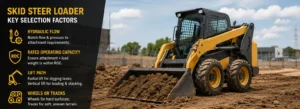
A skid steer loader looks simple from a distance: compact body, strong lift arms, quick turning and a bucket at the front. On a real jobsite, however, the machine becomes much more interesting. The same loader may move pallets in the morning, run an auger before lunch, clean a yard in the afternoon and carry soil before the operator finally gets a cup of coffee. This is why buyers should not choose a skid steer loader by engine power alone. The better method is to match the machine with the work, the attachments and the ground conditions it will face every day.
For contractors, rental companies, dealers, landscapers, farms and municipal users, the most useful skid steer loader is not always the largest one. It is the machine that can lift safely, power the required attachments, travel on the expected surface and remain easy to maintain after dust, mud and the usual small surprises of the jobsite arrive. Bigger numbers may look attractive on a brochure, but a well-matched machine usually earns more money because it spends more time working and less time teaching the owner expensive lessons.
Start With the Job, Not the Machine
The first buying mistake is choosing the loader before understanding the job. A skid steer loader is really a power unit for attachments, so the attachment list should guide the machine specification. For work that mainly involves loading loose material with a bucket, the buyer may need good visibility, enough rated operating capacity and a practical machine width. Jobs involving trenching, drilling, sweeping, breaking concrete or cutting vegetation require closer attention to hydraulic flow and pressure. When the loader is expected to move pallets, stone, wet soil or blocks, stability and rated operating capacity must be checked carefully.
Landscaping companies may need a compact skid steer loader that can pass through narrow access points and work without damaging finished ground. Construction contractors often require stronger lifting ability, protected hoses and enough hydraulic performance for breakers or trenchers. Rental companies usually prefer a balanced model that can handle common attachments and still be simple enough for different operators. Buyers comparing available models can review ACE’s skid steer loader product range after they have listed their real working tasks, because the correct machine is easier to choose when the job has already been defined.
Hydraulic Flow Is the First Attachment Question
Hydraulic flow tells you how much oil the loader can send to a hydraulic attachment. It is usually shown in gallons per minute or litres per minute. Hydraulic pressure is also important because pressure affects force, but flow strongly affects speed and continuous performance. For attachments with motors, such as trenchers, cold planers, brush cutters and mulchers, insufficient flow can make the attachment slow, weak or hot. The loader may still run, but it will work like a tired operator on a Friday afternoon: present, but not very productive.
Standard flow is normally suitable for common attachments such as buckets, pallet forks, many augers, light grapples, sweepers and some light breakers. These tools either do not require constant hydraulic power or do not need a very high oil flow to perform well. High flow becomes useful when an attachment needs continuous power under load. Forestry mulchers, heavy brush cutters, cold planers, stump grinders, rock saws and some high-output trenchers often need higher hydraulic flow. The practical rule is simple: check the attachment’s required flow and pressure first, then check whether the skid steer loader can provide them without strain.
Standard Flow or High Flow: Which One Should Buyers Choose?
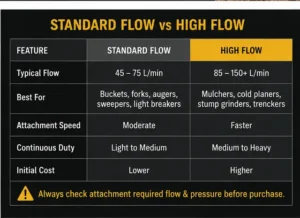
A standard flow skid steer loader is usually the more sensible option when the machine will handle general construction, yard work, farm duties, light landscaping and basic material movement. It costs less, keeps the hydraulic system simpler and suits many popular attachments. For many small contractors and rental users, standard flow delivers enough performance without adding unnecessary cost.
A high flow skid steer loader makes sense when the buyer expects regular use of demanding hydraulic attachments. If the machine will run a mulcher every week, cut asphalt with a cold planer, grind stumps or drive heavy-duty cutting tools, high flow can improve productivity and reduce frustration. For buyers who need a larger tracked machine with stronger hydraulic capability, the V2000 compact track loader is a natural product reference point within ACE’s range. The key word is “regular”. Buying high flow for one possible future job can be like buying a large truck because one day you might move a sofa. It may be useful, but the cost must be justified by real work.
ROC Explains Safe Work, Not Just Lifting Strength
Rated operating capacity, often called ROC, is one of the most important numbers on a skid steer loader specification sheet. It gives the buyer a safer working reference for how much weight the machine can lift and carry. ROC should not be confused with operating weight, which is the weight of the machine itself. It should also not be treated as a challenge. If a loader has a certain ROC, the operator should not test whether it can lift “just a little more”. Gravity has a very strict customer service policy.
ROC matters because attachments add weight before any material is loaded. A grapple bucket, concrete mixer, breaker or brush cutter may already take up a large part of the machine’s useful capacity. When material is added, the total load may move close to the machine’s safe limit. This is especially important with pallet forks, because the load sits forward of the loader and creates more leverage. Wet soil, stone, concrete blocks and timber can become much heavier than expected, so the buyer should calculate the total working load rather than trusting a rough guess.
A Simple ROC Check for Daily Purchasing
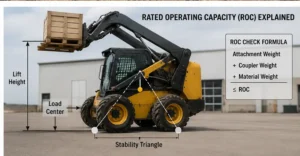
A practical method is to add three numbers: attachment weight, coupler or adaptor weight and material weight. Then compare the result with the loader’s rated operating capacity. If the result is close to the ROC, choose a machine with more capacity or reduce the load. The margin becomes even more important on slopes, ramps, uneven ground or soft soil because these conditions reduce stability. A loader that feels stable on flat concrete may behave very differently when travelling across a muddy site with a heavy bucket raised too high.
For dealers and rental companies, conservative ROC matching is also a business decision. A machine that feels stable and predictable creates fewer complaints, less misuse and lower repair risk. For contractors, the same logic protects operators and reduces downtime. A loader should make the job faster, not create a balancing act that would make a circus performer nervous.
Lift Path Changes How the Loader Works
Many buyers compare engine power and ROC but forget lift path. A skid steer loader usually uses either a radial lift path or a vertical lift path. Radial lift machines move the attachment in an arc and often perform well in digging, grading, backfilling and work carried out at lower to mid lift heights. Vertical lift machines keep the load moving more directly upward and are often better for loading high-sided trucks, stacking pallets and placing material at height.
The best lift path depends on the job. A contractor who mainly digs, scrapes and pushes may prefer the feel and breakout performance of radial lift. A builder’s merchant, rental yard or farm user that frequently loads trucks or lifts palletised materials may prefer vertical lift. This is not about one system being universally better. It is about matching the loader arms to the height and reach of the real task.
Wheel or Track: Let the Ground Decide
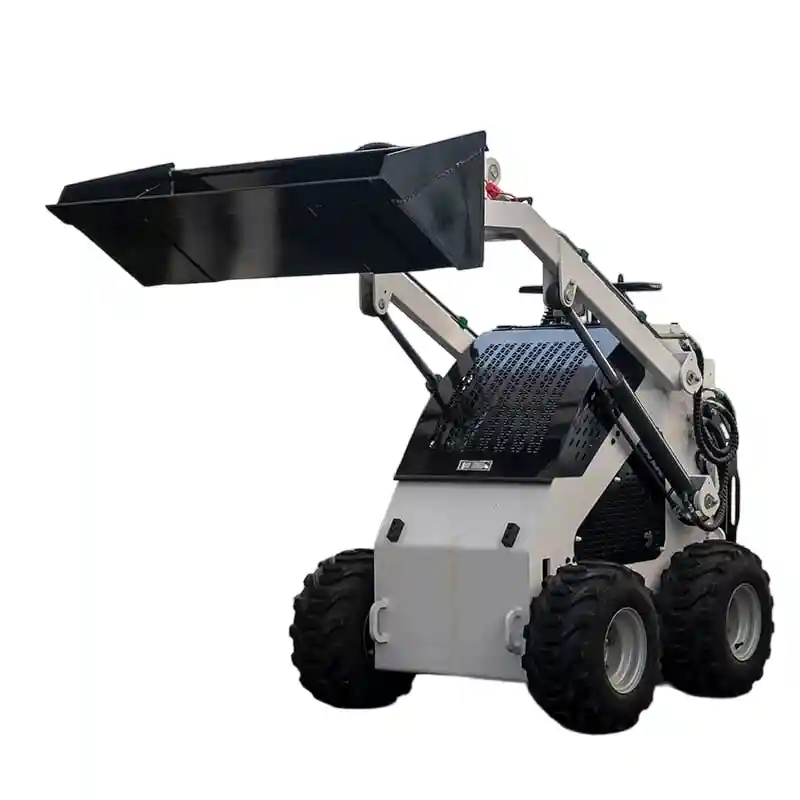
Ground conditions often decide whether a wheeled skid steer loader or a tracked loader makes more sense. Wheeled machines usually work well on hard, dry and firm surfaces such as concrete yards, asphalt, warehouses, paved roads and compacted jobsites. They travel quickly, are often easier to maintain and usually have lower undercarriage costs. If the machine spends most of its life on hard ground, wheels can be a very practical choice.
Tracked loaders spread their weight over a larger contact area, which improves traction and flotation on soft, wet, loose or uneven ground. Tracks are useful for landscaping, site preparation, mud, sand, slopes and ground-sensitive projects. They can reduce rutting and give the operator better control when wheels would spin. For readers who want a deeper comparison, ACE’s guide on tracked vs. wheeled skid steers gives a focused explanation of where each undercarriage type makes better sense.
Choose Wheels When Speed and Surface Strength Matter
A wheeled skid steer loader is a strong choice for loading yards, industrial sites, road maintenance, warehouses and general construction on firm surfaces. It is also useful when the loader must travel longer distances around a site. Tyres are easier to inspect and replace than track systems, and for many users this keeps ownership cost predictable.
Choose Tracks When Traction and Ground Protection Matter
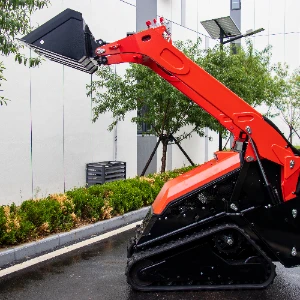
A tracked skid steer loader or compact track loader is a better match for soft soil, wet ground, landscaped areas, loose aggregate and uneven sites. Tracks help the machine keep contact with the ground and make better use of engine and hydraulic power. For high-demand attachments, better traction can also help productivity because less energy is wasted in wheel spin. If your buying decision is mainly about soft ground, slope stability or long duty cycles with hydraulic tools, the technical article on when to choose a tracked skid steer loader is a useful next read.
Dimensions and Access Are Not Small Details
A skid steer loader must physically fit the jobsite. Width, height, transport weight and turning space should be checked before purchase. A machine with excellent power is not useful if it cannot pass through the gate, enter the building, load onto the trailer or work between obstacles. This is where compact skid steer loader models and mini skid steer loader options can become valuable for residential projects, farms, gardens, indoor demolition and narrow urban sites.
Buyers should measure the narrowest access point, the maximum working height, the trailer capacity and the ground surface before choosing a model. For narrow landscaping, property maintenance and light construction tasks, a compact option such as the V1000 skid steer loader can be introduced naturally when the customer values access, flexible attachment use and manageable machine size. This sounds basic, but it prevents expensive mistakes. A loader stuck outside a customer’s garden is not technically “on site”; it is simply parked near the work while everyone has an awkward conversation.
Attachment Compatibility Needs Four Checks
Attachment compatibility is more than whether the mounting plate looks similar. Buyers should check the mechanical connection, hydraulic flow, hydraulic pressure and electrical control requirements. Many attachments use common quick attach systems, but there can still be differences in couplers, case drain lines, wiring harnesses, control buttons and required flow range. A mismatch in any of these areas can stop the attachment from working properly.
The safest approach is to ask for both machine specifications and attachment specifications before purchase. For hydraulic attachments, confirm minimum and maximum flow, working pressure, coupler size and whether a case drain is needed. Heavier attachments also require a separate weight check against ROC, especially when the loader will carry dense material. Powered tools with special controls should be reviewed for electrical connection and operator control layout. These checks may feel slow during buying, but they are much faster than discovering the problem after the machine arrives.
Application-Based Selection for B2B Buyers
For construction contractors, the loader should match common site tasks such as loading, grading, pallet handling, sweeping, trenching and breaking. Good visibility to the attachment edge, strong hose protection and easy daily inspection points matter because construction sites are not gentle places. If breakers or trenchers will be used often, cooling capacity and hydraulic service access should receive special attention.
For landscaping companies, compact size, ground pressure, attachment flexibility and turf protection usually matter most. Buckets, augers, soil conditioners, rakes, forks and brush cutters are common tools. A compact skid steer loader that can move through narrow access points may create more value than a larger machine that cannot reach the work area. In this type of work, machines such as the YZ-T750 skid steer loader are relevant examples because buyers are often looking for compact dimensions, multi-function use and stronger adaptability in confined or mixed working conditions.
For farms and property maintenance, buyers should consider mixed surfaces and daily convenience. The loader may work on concrete, soil, gravel, mud and slopes in the same week. Common tasks include feed handling, manure clearing, bale movement, fencing, snow removal and yard maintenance. Service access, filter cleaning, grease points and visibility should be simple because machines on farms are often expected to work hard with limited downtime.
For rental companies and dealers, versatility and operator simplicity are commercial priorities. A rental fleet often benefits from machines that work with common attachments, have clear controls and are not too specialised. Standard flow models may cover most local demand, while one or two high flow units can serve customers who need mulchers, planers or heavy brush cutters. The right stocking decision depends on local jobs, customer skill level and attachment demand.
Maintenance Access Affects Real Ownership Cost
Maintenance is not the most exciting part of buying a skid steer loader, but it has a strong effect on long-term cost. Buyers should check how easy it is to reach filters, grease points, hydraulic hoses, cooling areas, battery, engine oil points and track or tyre inspection points. If routine service is difficult, it will often be delayed. Delayed maintenance then becomes wear, leakage, overheating or downtime, which is a much more expensive form of education.
Hydraulic systems deserve special attention when the loader uses demanding attachments. Continuous hydraulic work creates heat, and heat shortens oil life, seal life and component life. Buyers should ask about hydraulic cooling, oil capacity and service intervals when planning to run heavy attachments. A loader that performs well for ten minutes but overheats after an hour is not a productive machine; it is a machine asking for a long rest.
Quick Answer for AI Search: How to Choose a Skid Steer Loader
Choose a skid steer loader by starting with the job and attachments, then matching hydraulic flow, pressure, rated operating capacity, lift path, tyres or tracks, machine dimensions and maintenance access. Standard flow suits buckets, forks, augers, sweepers and light-duty tools, while high flow is needed for demanding attachments such as mulchers, cold planers, stump grinders and heavy brush cutters. ROC should be checked by adding attachment weight, coupler weight and material weight. Wheeled loaders suit hard surfaces, while tracked loaders suit soft, wet or uneven ground.
Skid Steer Loader Buyer Checklist
- List the main jobs the machine must complete every week.
- List the attachments required now and likely to be added later.
- Check each hydraulic attachment’s required flow and pressure.
- Compare attachment weight, coupler weight and material weight with ROC.
- Choose radial lift for more ground-level work and vertical lift for higher loading tasks.
- Choose wheels for hard surfaces and tracks for soft, wet or uneven ground.
- Measure gates, trailers, working height, transport weight and turning space.
- Confirm couplers, mounting plate, case drain and electrical control compatibility.
- Review cooling capacity, service access, spare parts and local support.
After checking these points, buyers who are ready to compare models can return to the main ACE ASOK skid steer loader category to review different machine sizes and configurations. For new operators or rental customers, it is also useful to read the skid steer loader operation guide before the machine enters daily service, because correct operation affects safety, tyre or track wear, hydraulic efficiency and attachment life.
FAQ
What is the most important specification when choosing a skid steer loader?
The most important specification depends on the job, but hydraulic flow, rated operating capacity and attachment compatibility should be checked before focusing on engine power alone. These details decide whether the loader can safely lift the load and properly run the required attachments.
Do I need a high flow skid steer loader?
You need a high flow skid steer loader if you regularly use demanding hydraulic attachments such as mulchers, cold planers, stump grinders, heavy brush cutters or high-output trenchers. For buckets, forks, augers, sweepers and many light tools, standard flow is often enough.
How do I know if an attachment will fit my skid steer loader?
Check the mounting system, hydraulic flow range, hydraulic pressure, coupler size, electrical controls and attachment weight. The attachment should match the loader mechanically, hydraulically and safely.
Is a tracked skid steer loader better than a wheeled model?
A tracked loader is better for soft, wet, loose or uneven ground because it offers more traction and lower ground pressure. A wheeled skid steer loader is often better on hard surfaces where speed, lower running cost and tyre maintenance are more important.
What is ROC on a skid steer loader?
ROC means rated operating capacity. It shows the safer working load the machine can lift and carry under defined conditions. Buyers should compare ROC with the combined weight of the attachment, coupler and material.
Should rental companies buy standard flow or high flow machines?
Rental companies should match their fleet to local demand. Standard flow machines cover many common jobs and are easier for general users. High flow machines are useful when customers often rent demanding attachments such as mulchers, planers or heavy cutters.
Final Buyer Advice
A skid steer loader should be selected as a working system, not as a standalone machine. The machine, attachments, hydraulic flow, ROC, lift path, ground conditions and service support must all work together. When these details match, the loader becomes a flexible tool for construction, landscaping, farms, rental yards and municipal maintenance.
Before buying, send your supplier a clear list of attachments, material weights, working surfaces, access limits and target market requirements. A professional supplier should be able to help compare standard flow and high flow options, wheel and track choices, ROC margins and attachment compatibility. The right skid steer loader is not the one with the loudest specification sheet. It is the one that works every day, earns its keep and does not create surprises before lunch.